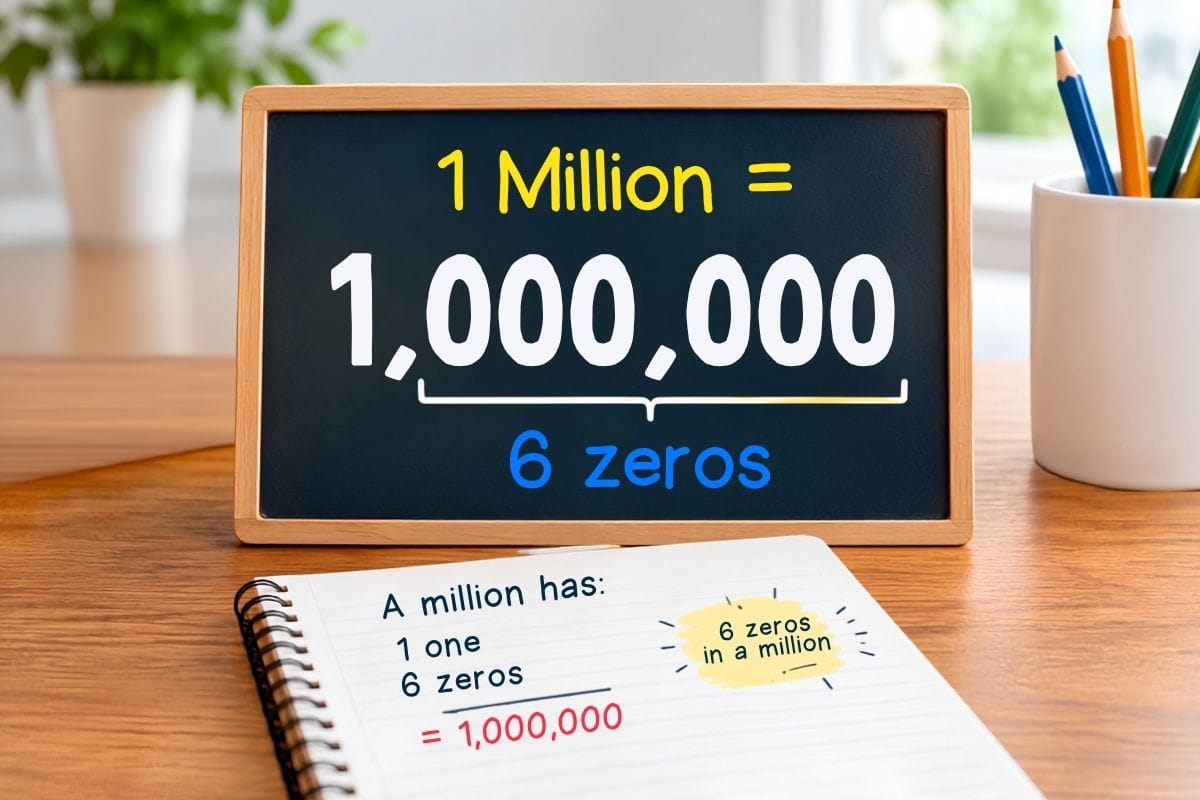
Quick Answer: A million has six zeros. It’s written as 1,000,000 (a solo 1 with six zeros), or 1 × 10⁶ in scientific notation.
Suppose you’re in a meeting, someone flashes a slide with a big number on it, and your brain freezes. But if you’ve ever typed “how many zero is in a million” into Google at 2 a.m., welcome to a very large club. Even execs with corner offices trip on this one. Let’s find an answer.
Key Points
- One million = 1,000,000 (six zeros).
- It falls right between 999,999 and 1,000,001.
- A billion has 9 zeros and a trillion has 12 zeros.
- Dollars, pounds, rupees… the zeros don’t care what money you use.
How Many Zero Is in a Million? The Step-by-Step Answer
Zero gets a bad rap for being “nothing”. Don’t buy it. Add one on the end of a number, and that number gets ten times bigger. The folks at HowManyZeroes compare every extra zero to adding a whole new layer of size.
A thousand (1,000) has 3 zeros. Ten thousand (10,000) has 4. A hundred thousand (100,000) has 5 zeros. And a million (1,000,000)? Six.
PrepScholar states that from 1,000 upward, each new level just tacks one more zero onto the last. Keep going and ten million (10,000,000) lands at 7 zeros, while a hundred million (100,000,000) has 8.
The Trick: Count Groups of Three
You don’t have to count zeros one by one. In the US, we place a comma after every three digits (counting from the right), and those commas make it easier to read. Try saying 1000000 out loud. Now try 1,000,000. Way better, right?
So picture a million as 1(000)(000). Two sets of zeros. A billion gets three sets, and a trillion gets four. ThoughtCo explains why this trick saves you once numbers get silly. Counting 27 zeros for an octillion is a headache, and counting 303 for a centillion is basically a punishment. Nine groups and 101 groups are much easier.
Also Read – Inter vs Intra
Million, Billion, Trillion, and Beyond
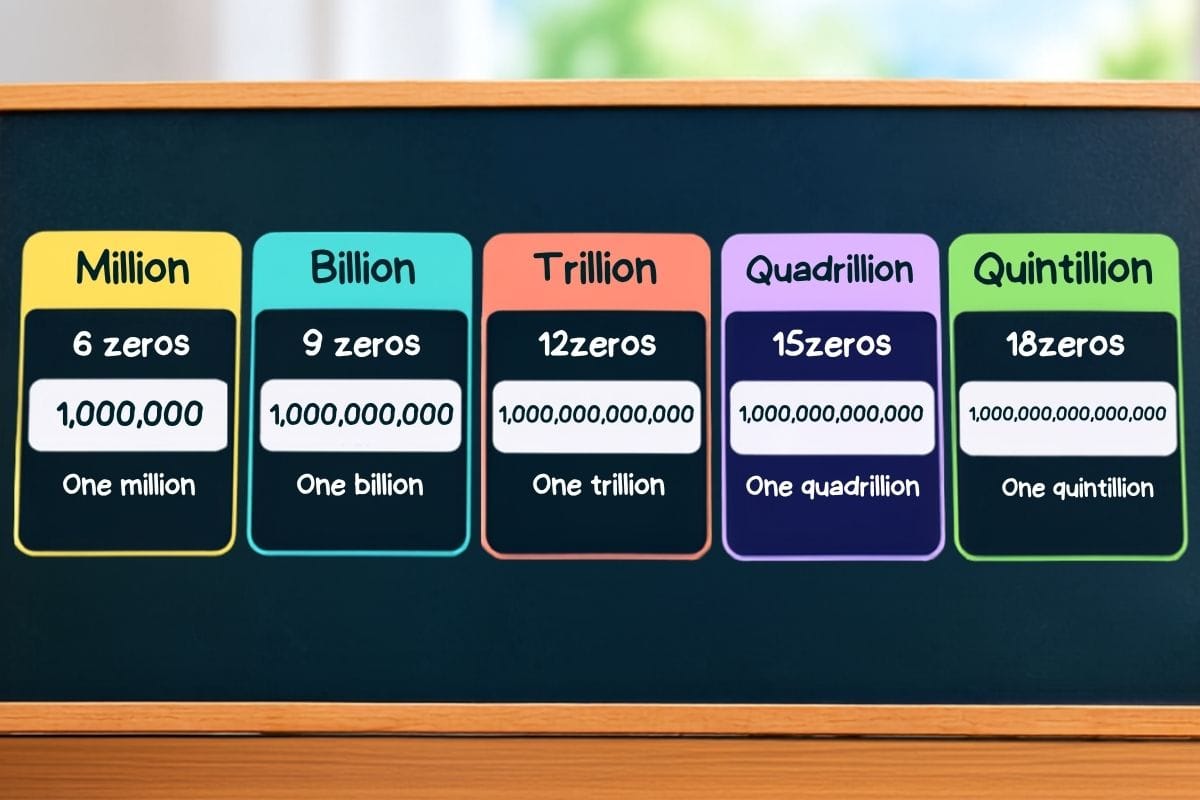
Past a thousand, the pattern never changes: every new name adds three more zeros. This chart uses the short scale, which is what the US uses.
| Name | Zeros |
| Thousand | 3 |
| Million | 6 |
| Billion | 9 |
| Trillion | 12 |
| Quadrillion | 15 |
| Quintillion | 18 |
| Sextillion | 21 |
| Septillion | 24 |
| Octillion | 27 |
| Nonillion | 30 |
| Decillion | 33 |
| Undecillion | 36 |
| Duodecillion | 39 |
| Tredecillion | 42 |
| Quattuordecillion | 45 |
| Quindecillion | 48 |
| Sexdecillion | 51 |
| Septendecillion | 54 |
| Octodecillion | 57 |
| Novemdecillion | 60 |
| Vigintillion | 63 |
| Centillion | 303 |
Multiply them, and you just add the zeros. A million billion has 15 zeros and is better known as a quadrillion. A million trillion comes out to 18 zeros, which is a quintillion.
Meet the googol: a 1 followed by 100 zeros. The name came from Milton Sirotta, the young nephew of mathematician Edward Kasner. Even a googol is bigger than the estimated count of atoms in the observable universe. A googolplex is a 1 followed by a googol of zeros. You couldn’t write that one out even with the whole universe as scrap paper.
Common Mix-Ups People Make
Mix-up number one: thinking a lakh and a million are the same. Nope! A lakh is 100,000, so five zeros. A million is 1,000,000, so six. One extra zero, and suddenly you’re off by ten times.
Mix-up number two? Those commas. The US writes a million as 1,000,000, but India writes the same number as 10,00,000.
Also Read – What Are Zentangle Patterns
Short Scale vs. Long Scale
“Million” means 1,000,000 in both systems, with six zeros every time. The difference becomes clear one step up.
The US runs on the short scale, where a billion is a thousand million (9 zeros). Science and finance worldwide use it, too. France, though, sticks with the long scale, where a billion means a million million, or 12 zeros. The UK used the long scale for ages before officially jumping to the short scale in 1974. And the labels themselves? French mathematician Geneviève Guitel described “short scale” and “long scale” back in 1975.
Where the Word “Million” Comes From
Merriam-Webster traces “million” back to the Old Italian word “milione”. Which grew out of “mille”, meaning “thousand.” So a million was basically “a great thousand.” English picked the word up in the 14th century.
Trivia time: GeeksForGeeks says that Roman numerals don’t have an official symbol for a million. People usually write an M with a bar on top (M̅). That bar means “multiply by 1,000,” so you get 1,000 × 1,000.
Also Read – What Makes Heterogeneous and Homogeneous Mixtures Different
A Million in Real Life
Imagine winning $1 million on a game show. That check won’t just say “1 million.” It’ll say $1,000,000, and those six zeros have never looked better.
Influencers throw parties when they hit 1 million followers. Viral YouTube videos blow past 1 million views before lunch. A million cookies? Six zeros of sugar crash.
Thirty million? That’s 30,000,000, so seven zeros once you count the one in 30.
FAQs
1. How many zero is in a million dollars?
Ans: Six: $1,000,000. Swap in pounds, euros, or rupees, and the count doesn’t change.
2. How many zero is in 10 million?
Ans: It has seven zeros, and it’s written as 10,000,000.
3. How many zeros are in a billion?
Ans: Nine, if you’re going by the US short scale (1,000,000,000). The long scale gives it 12.
4. Is 1 million the same as 10 lakh?
Ans: Yes, same number. India just writes it as 10,00,000, and it still has six zeros.
5. What is a million in scientific notation?
Ans: It’s 1 × 10⁶. That little 6 up top tells you exactly how many zeros come after the 1.
6. How many “noughts” are in a million?
Ans: “Noughts” is simply the British way of saying zeros. So a million has six noughts, same as always.
Sources & References:
- ThoughtCo. – Counting 27 zeros for an octillion is a headache, and counting 303 for a centillion is basically a punishment.
- PrepScholar – From 1,000 upward, each new number just adds one more zero onto the last.
- GeeksForGeeks – Roman numerals don’t have an official symbol for a million.
- Howmanyzeros – A thousand (1,000) has 3 zeros, ten thousand (10,000) has 4, hundred thousand (100,000) has 5 zeros, and more.