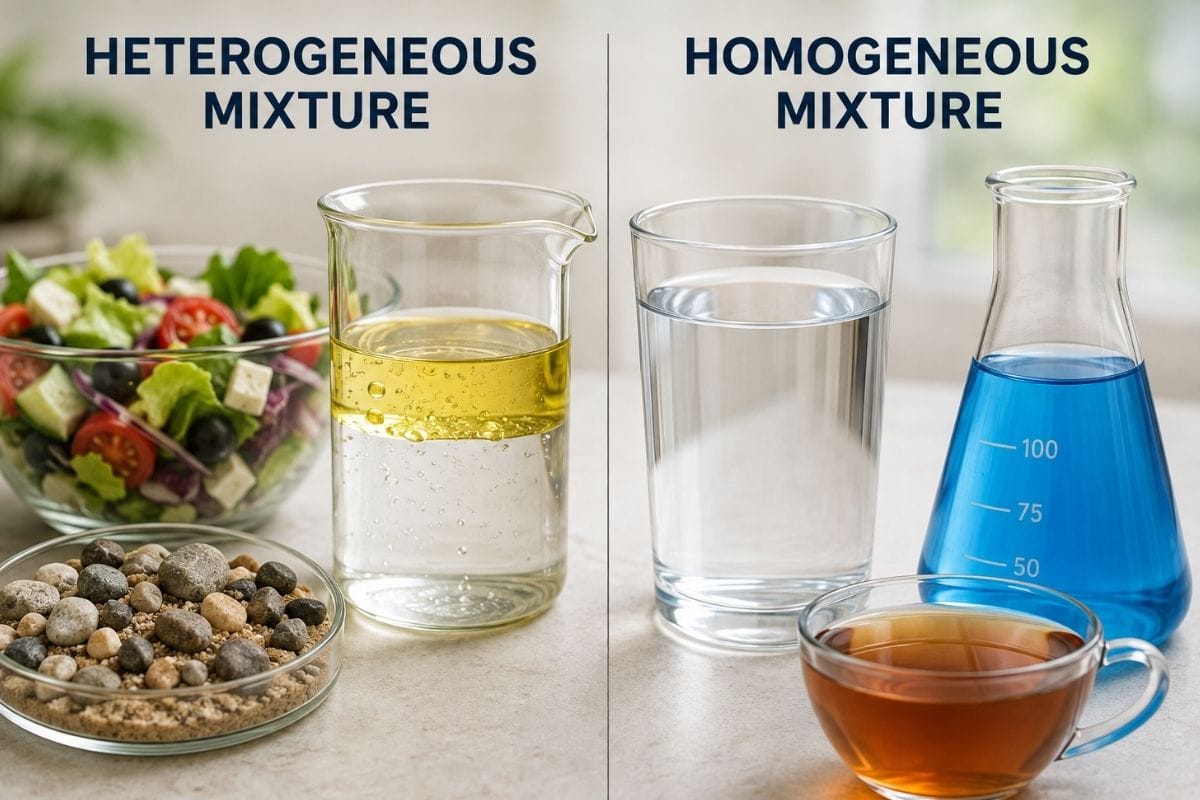
Quick Answer: A homogeneous mixture looks identical everywhere and shows one phase of matter. A heterogeneous mixture has visible parts spread unevenly across two or more phases. Uniformity is the entire difference.
All mixtures, heterogeneous and homogeneous alike, are physical blends. Nothing bonds chemically. Salt still tastes like salt in water, and raisins still stay raisins in trail mix. Only the spread of the parts changes.
- Homogeneous means uniform composition, one phase, and hidden parts.
- Heterogeneous means uneven composition, two or more phases, and visible parts.
- Solutions are homogeneous. Colloids and suspensions are heterogeneous.
- No bonds form in either type, so ingredients keep their identity.
- Sample size can change the answer, which can be confusing.
What Counts as a Mixture?
Elements and compounds are pure substances. A compound holds one kind of molecule, built from atoms locked by bonds. A mixture works differently. Two or more substances sit side by side, mingled physically, with no bonds between them.
Diffen frames the idea well: every component keeps its own identity. Melting and boiling points still come from the ingredients, and no energy is gained or lost.
Homogeneous Mixtures: One Look, One Phase

The composition matches in every spoonful. The parts occur in the same proportion everywhere, so you cannot pick them out by eye. Only one phase shows at a time, so a solid and a liquid never appear together.
Salt water is the classic case. Sip the top or the bottom, and the taste matches. These blends have another name: solutions.
Also Read – What Are Zentangle Patterns and How to Start
Heterogeneous Mixtures: Parts You Can Point At

The ingredients spread unevenly here. Two or more phases exist, and one region has properties another lacks, even in the same state of matter. GeeksforGeeks draws the line plainly: the boundary between the parts stays visible.
Oil and water split because their densities differ. Sand sinks in water. Water, octane, and silicone grease separate too, since that blend mixes water-loving and water-fearing compounds.
| Feature | Homogeneous | Heterogeneous |
| Composition | Uniform throughout | Not uniform |
| Phases present | One | Two or more |
| Can you see the parts? | No | Yes |
| Separated by hand or filter? | No | Yes |
| Word root | “Homo” means same | “Hetero” means different |
| Also called | Solution | Colloid or suspension |
| Chemically bonded | No | No |
| Examples | Steel, vinegar, air | Salad, granite, blood |
Everyday Examples of Each
Homogeneous: air, sugar water, rainwater, seawater, vinegar, vodka, brewed coffee, detergent, crude oil, gasoline, and mouthwash. Alloys count too: steel, brass, bronze, and sterling silver.
Heterogeneous: cereal in milk, pizza toppings, ice in soda, salad, trail mix, mixed nuts, soup, gravel, soil, mud, granite, concrete, and sand with iron filings.
Two surprise people. Blood looks smooth and red, yet its cells and plasma stay separate. And while air is homogeneous, Earth’s atmosphere is not, since clouds prove the composition shifts.
Three Families: Solutions, Colloids, and Suspensions
Solutions are homogeneous. Colloids and suspensions are heterogeneous. Particle size sets the three apart.
Solutions hold particles under about 2 x 10⁻⁹ meters, so you cannot tell solute from solvent. The solvent is the larger fraction and is the one that does the dissolving. Water-based ones are aqueous. The mass ratio of solute to solvent is the concentration.
Colloids hold particles between 2 x 10⁻⁹ and 5 x 10⁻⁷ meters. They never settle, since forces between molecules beat gravity. Adda247 sorts them into sol (ink, paint), foam (whipped cream), emulsion (milk, dressing), aerosol (fog, hairspray), and gel (jam, cheese). Colloids scatter a light beam.
Suspensions hold particles above 5 x 10⁻⁷ meters, big enough to spot under a microscope. They settle or float over time and need stirring again, and filter paper traps them. Muddy water, paint, and whitewashed lime all count.
Also Read – Inter vs Intra
Types of Solutions by State
A solute is phased by the solvent when the solvent is larger.
- Gas in gas: air. Gas solvents dissolve only gases.
- Gas in liquid: carbon dioxide in soda, oxygen in water.
- Liquid in liquid: ethanol in water, which is every alcoholic drink.
- Solid in liquid: sugar or salt in water. Not all qualify; some are colloids or suspensions.
- Gas in solid: hydrogen in palladium.
- Liquid in solid: mercury in gold, called an amalgam, plus moisture in salt.
- Solid in solid: alloys like steel, brass, and bronze.
Scale Can Change the Answer
Get pedantic and the line blurs. Sample down to one molecule, and anything looks heterogeneous. Sample the whole batch, and it looks uniform. ThoughtCo uses beach sand here. Up close, you spot shells, coral, and organic bits. From a distance, it reads as one material.
So chemists lean on a rule of thumb. If the property you care about holds in every sample, the mixture is homogeneous.
How Each Type Gets Separated
Heterogeneous mixtures give in easily. Pick ice from soda, filter sand from water, sort candy by color, or let sediment settle.
Homogeneous mixtures resist mechanical tricks, but they are not locked shut. Distillation, evaporation, and chromatography pull solutions apart. Boil salt water, and dry salt is left behind.
Heat, stirring, and time can flip a mixture from one type to the other. Add dye to water, and it starts uneven, then spreads until it looks uniform. Entropy does that work.
FAQs
What is the main difference between homogeneous and heterogeneous mixtures?
Ans: Homogeneous mixtures are uniform and show one phase. Heterogeneous mixtures are uneven, with two or more phases you can see and often separate by hand.
Is milk homogeneous or heterogeneous?
Ans: Milk looks uniform, so people often call it homogeneous. Technically, it is a colloid, an emulsion of fat droplets in water, which makes it heterogeneous.
Is air a homogeneous mixture?
Ans: Yes. Air blends nitrogen, oxygen, argon, carbon dioxide, and neon evenly. The wider atmosphere is heterogeneous because clouds show that its composition is inconsistent.
Are all solutions homogeneous mixtures?
Ans: Yes. Every solution is homogeneous because the dissolved solute sits in the same amount throughout. Salt water, vinegar, and steel all fit.
Can a homogeneous mixture be separated?
Ans: Not by hand or simple filtering. Distillation, evaporation, and chromatography do work, which is why boiling salt water leaves dry salt behind.
Is blood homogeneous or heterogeneous?
Ans: Blood is heterogeneous. Red cells, white cells, platelets, and plasma stay distinct, and a centrifuge spins the cells away from the plasma.
Sources & References:
- Diffen – Every component in a mixture has its identity.
- Adda 247 – Colloids can be sol (ink, paint), foam (whipped cream), emulsion (milk, dressing), aerosol (fog, hairspray), or gel (jam, cheese).
- Geek For Geeks – In a heterogeneous mixture, the boundary between the parts remains visible.
- ThoughtCo. – You can use beach sand to differentiate heterogeneous and homogeneous mixtures.