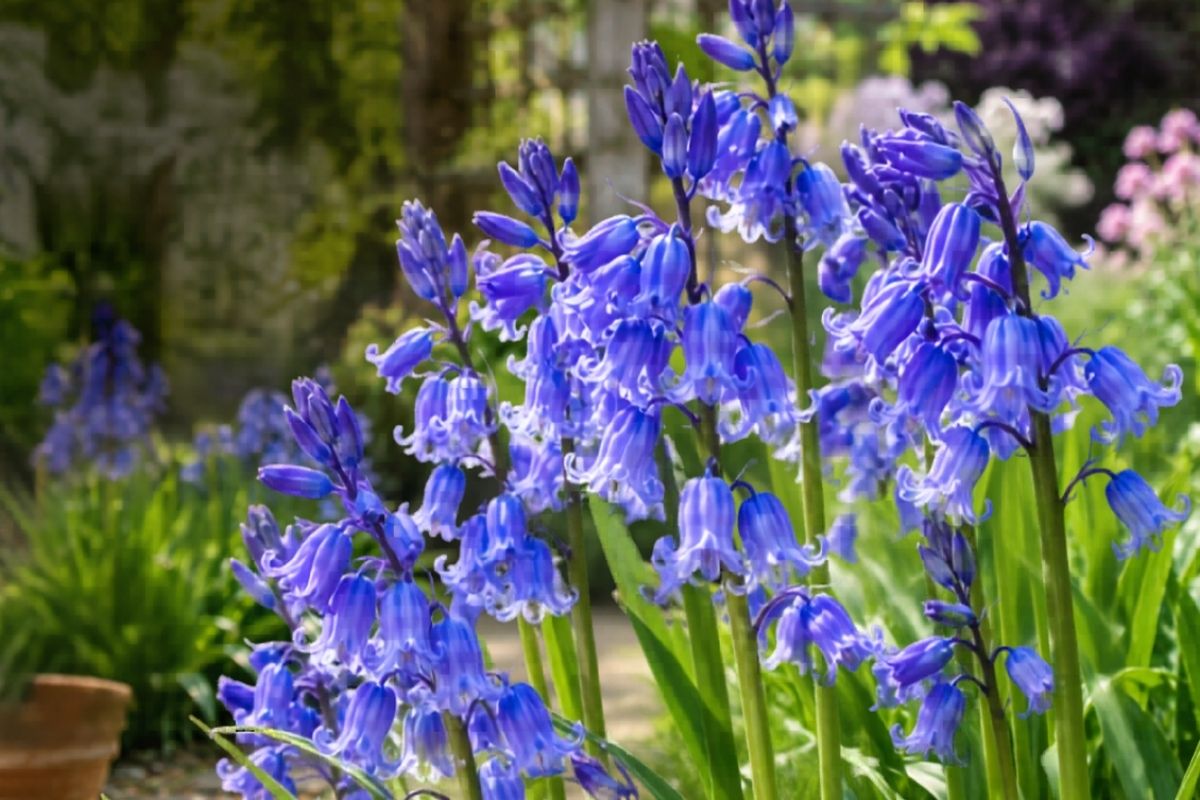
Imagine a woodland floor covered entirely in blue – it’s one of the most cherished scenes in Britain. However, not every bluebell that you see there is native.
Spanish Bluebells (Hyacinthoides hispanica) have indeed been spreading from UK gardens into the countryside over the past few decades without people’s awareness of the distinction between them and our native species.
Here we are explaining which Spanish Bluebells are – their significance, why they should concern us, what studies really show, and what you can do. If you are an enthusiastic gardener, a nature lover, or just a person who saw a strange plant in the flowerbed, this handbook is what you need.
Key Statistics and Data: The Scale of the Problem
Statistics regarding Spanish Bluebells in the UK are truly staggering:
- Nearly 50% of the world population of native bluebells (Hyacinthoides non-scripta) can be found in the UK, making Britain their main habitat.
- Spanish Bluebells were first introduced into British gardens as ornamental plants in the late 17th century. It is said they have been escaping into the wild and spreading ever since.
- According to a 2011 survey by Plantlife, hybrid bluebells (resulting from a cross between native and Spanish species) now cover a large part of England and Wales.
- The native bluebell is recognized as a Species of Principal Importance according to the Natural Environment and Rural Communities (NERC) Act 2006, which shows how seriously the government associates its conservation.
- Taking native bluebells from the wild without a license is a criminal offense under the Wildlife and Countryside Act 1981.
All these aspects show that the topic at hand is not only a matter of gardening but of conservation as well.
Also Read – How to Create an Eco-Friendly Home Without Spending Too Much
Spanish Bluebells vs Native Bluebells: How to Tell Them Apart
To take effective steps against Spanish Bluebells, you must be able to identify them first. Here is an easy guide:
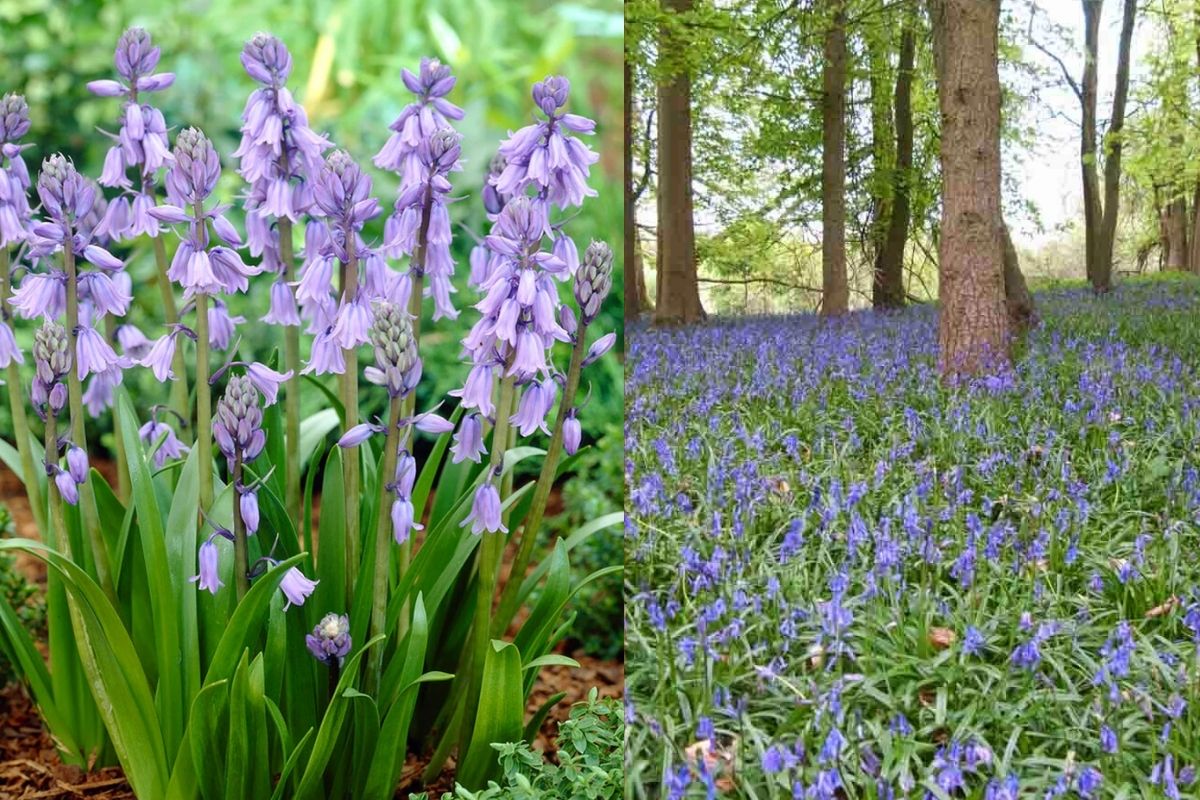
Step 1 – Observe the flower’s appearance
Indigenous bluebells have slender, tube-like flowers that hang down at the tip like tiny bells. Spanish bluebells have the wider, open bell-shaped flowers that spread out. They appear a little robust and less delicate.
Step 2 – Notice which side the flowers are growing on
Typically, native bluebells only have their flowers hanging from one side of the stem. This way, the plant obtains its characteristic drooping, arching appearance. Spanish bluebells, on the other hand, have flowers growing all the way around the stem. So these plants look more upright and symmetrical.
Step 3 – Give It a Sniff
This is a very simple tip. The scent of native bluebells is sweet and very characteristic. The Spanish Bluebells, on the other hand, are without scent or hardly a scent at all.
Step 4 – Look at the Petal Colour
The native bluebell petals are a rich violet-blue shade, and their pollen is cream-coloured. On the other hand, Spanish Bluebells are not only blue, but also come in pink and white, and their pollen is either blue or pale blue.
Step 5 – Check the Leaves
It’s easy to see that Spanish Bluebell leaves are much wider and flatter compared to the thin, strap-like leaves of the native species.
Also Read – A Real Look at Cost of Living in Italy vs USA and Where You Save More
Actionable Tips: What You Can Do
No need to worry, but it’s always a wise idea to take some steps to safeguard our native bluebells.
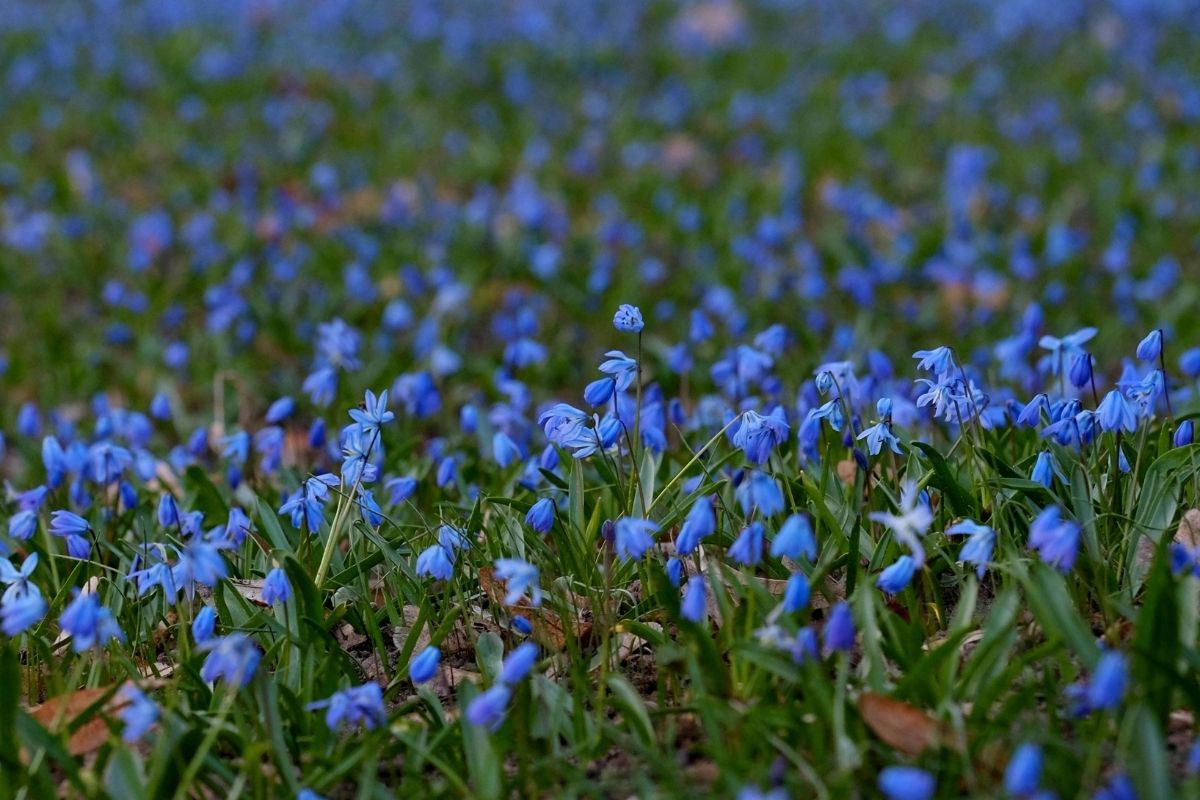
- If you are living near forests or nature reserves, then avoid buying Spanish Bluebells for your garden. Instead, you should go for native bluebell bulbs from reliable and wildlife-friendly suppliers such as the Wildlife Trusts or Plantlife.
- When you are removing Spanish Bluebells, do so with caution and by digging up the entire bulb rather than pulling up the stem only. Put all parts – including seeds – in tightly sealed bags and throw them away in your regular waste bin instead of the compost heap.
- Don’t give up. For every growing season, plan to take any removal action, as it will be necessary to check for re-growth each time.
- Be careful when visiting the bluebell woods. Follow the footpaths and avoid spreading seeds on your boots or clothes. Never dig up wild bulbs.
- If you come across Spanish Bluebells or hybrids in wild areas, please report them to the Botanical Society of Britain and Ireland (BSBI) through their online recording platform.
- By planting native species in your garden, you will help pollinators and local wildlife, even though you will not be planting bluebells. Bluebells are the food source for bumblebees, hoverflies, and various moth species.
Conclusion: Small Choices, Big Difference
Spanish Bluebells are definitely not the bad guys here – they are lovely plants that, unfortunately, got into an area where they shouldn’t be. However, it is quite crucial to know the impact of these plants on our native environment, especially since Britain is home to a large percentage of the global native bluebell population.
The great thing is, you don’t need to know a lot about plants to make a difference. Figure out plants in your own garden, make wise decisions about what to plant, and get involved with groups that are trying to protect the bluebell woodlands.
After this, the natural thing to do is to go to your garden this spring and try to identify your bluebells by following the instructions in this guide. If you spot Spanish Bluebells next to a natural area, think about getting rid of them this season – and planting natives instead. It’s the small things that make a big difference.
Also Read –
Are Spanish Bluebells illegal in the UK?
No, it is not illegal to have Spanish Bluebells in your garden. However, spreading invasive non-native plants into the wild is illegal. The Wildlife and Countryside Act 1981 states it is an offence to allow invasive non-native species to spread into the wild. You are therefore responsible for making sure they do not spread out of your property.
Do Spanish Bluebells and native bluebells interbreed?
They do and interbreed continually. In fact, the hybrids produced (Hyacinthoides × massartiana) are fertile and may even backcross to native populations. This raises the biggest conservation concern.
Are Spanish Bluebells detrimental to wildlife?
Yes, indirectly. If hybrids drive native bluebells out, then native woodland specialist insects dependent on them would be impacted. Native bluebell woodlands are a critical habitat for several species in the UK.
Is there still time to change things?
Of course not. Different individual gardening choices, particularly in rural and semi-rural areas, do actually matter, say conservation organizations. When small changes are implemented in millions of gardens, their impact is real.
References
Plantlife International (2011). Bluebell Survey Report. Plantlife, Salisbury, UK.
Botanical Society of Britain and Ireland (BSBI). Hyacinthoides hispanica species account.
Pellicer, J., & Leitch, I.J. (2015). “Genome size diversity and its impact on the evolution of land plants.” Botanical Journal of the Linnean Society, 177(1), 1–32.
Natural England (2019). Species of Principal Importance in England.
Wildlife and Countryside Act 1981. UK Government legislation.
Natural Environment and Rural Communities (NERC) Act 2006. UK Government legislation.
The Wildlife Trusts. How to identify bluebells.