English is the most widely spoken language in the world. People of 180 countries speak it. However, there are some languages that are not easy to learn as an outsider.
Some of the hardest languages to learn are Mandarin Chinese, Arabic, Japanese, Hungarian, and many more.
- Mandarin has 4 tones and 50,000 characters
- Arabic has a right-to-left script
- Japanese is a combo of 3 writing styles
- Korean grammar is the opposite of English grammar
- Polish and Russian are different in word structure and pronunciation
Why Some Languages Push Learners to Their Limits
Every language can be learned. But some languages need more effort. The language difficulty can vary from person to person.
For example, a Spanish person can speak Italian, but an ordinary English speaker may not understand Korean or Thai. This is because some languages have similarities, while others are totally different. These are the factors that make languages challenging:
- Sentence structure
- Writing systems
- Pronunciation difference
- Syntax & morphology
According to ActiveLoc, it may take years for a person to master a language.
1. Mandarin Chinese
Mandarin Chinese is ranked among the hardest languages to learn.
The biggest challenge is its four tones. The 1st tone is high and flat, like 妈 (mā, “mother”), the 2nd tone rises upward, like 麻 (má, “hemp”), the 3rd tone falls and then rises, like 马 (mǎ, “horse”), and the 4th tone drops sharply, like 骂 (mà, “to scold”).
Mandarin is the most spoken native language in the world. More than 1.1 billion people speak in different nations.
2. Arabic

Arabic is a member of the Afro-Asiatic (Semitic) language family. Its script is taken from the Nabataean alphabet.
Learners struggle with Arabic because it is written from right to left. Elite Asia points out that Arabic has many dialects, and spoken Arabic changes from one country to another.
Some letters and sounds are also difficult to pronounce because of deep throat sounds, consonants, and vocal friction.
Also Read – History of Sicily, Italy
3. Japanese

Japanese is another language that should be on the list of the most difficult languages in the world.
One reason is the writing system. Japanese uses hiragana, katakana, and kanji together. Kanji came from Chinese characters and can take years to master.
The language also changes depending on politeness and social situations, which can confuse beginners.
4. Korean

The Korean language is from the language family of the ancient Proto-Koreanic peoples in Manchuria and the Korean Peninsula.
Its alphabet, Hangul, has 24 basic letters (14 consonants and 10 vowels). Even though Hangul is simple to learn, Korean grammar is not.
Sentence order and words are changed based on the listener’s age and respect.
5. Russian

Russian uses the Cyrillic alphabet, which is not easy to learn.
The grammar is another big challenge. Drops clarifies that words change form depending on how they are used in a sentence. Russian pronunciation is not easy to understand because some sounds do not exist in UK/US English.
It is one of the most widely spoken languages in Europe and Central Asia.
6. Polish

Polish is known for difficult pronunciation and long words full of consonants.
Some Polish words look almost impossible for beginners to read. The language also uses gender rules and grammatical cases.
Polish is similar to other European languages, so Europeans may learn it faster than others.
Also Read – Cost of Living in Italy vs USA
7. Finnish and Hungarian
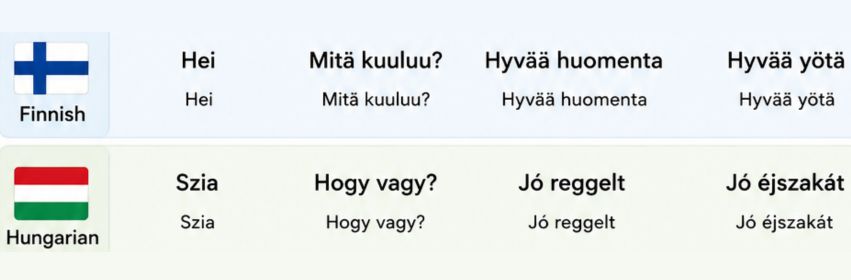
Finnish and Hungarian are popular for their grammar.
Both languages use many endings instead of extra words. Dulingo believes that a single word can change shape several times in Finnish and Hungarian depending on the meaning.
Their vocabulary is also very different from English, which makes memorizing words harder for beginners.
8. Thai

Thai is another language that is the hardest for English speakers because it uses tones.
Changing the tone changes the meaning completely. Thai also has its writing system and does not clearly separate every word with spaces.
That can make reading difficult in the beginning.
9. Italian

Italian may not be as difficult as Japanese or Arabic, but it still has challenges.
Many native speakers talk rapidly, which can make conversations challenging to follow. Italian verbs also change a lot depending on tense and subject.
Still, Italian is often considered one of the more beautiful languages in the world. It is also known as the language of opera because many famous operas were written in Italian first.
In Short
The hardest languages to learn are usually the ones that feel far away from English in grammar, writing, and pronunciation. Mandarin Chinese, Arabic, Japanese, Korean, and Russian continue to rank among the most difficult languages in the world for many learners.
There is no doubt that the above-mentioned languages are difficult to learn, but with daily practice and patience, you can conquer them.
Also Read – The Real Winter Food Scene in Italy Right Now
- Which is the hardest language to learn?
Ans: Mandarin Chinese is the hardest. To master it, an individual has to do more than 2,200 hours of study.
- Why is Arabic difficult?
Ans: Because Arabic is written left to right, it has many dialects and includes sounds that can be strange to a learner.
- Is Italian hard to learn?
Ans: As compared to other Asian languages, Italian is not that hard. However, grammar and pronunciation can be a tough row to hoe.
- Why is Japanese so challenging?
Ans: Because Japanese uses three writing systems, the speaker has to change the tone based on the situation.
Sources & References:
ActiveLoc – It may take months or years to learn a difficult language.
Elite Asia – Arabic has so many dialects, and it may change in different countries.
Drops – In Russian, the words change their form depending on their grammatical role in the sentence.
Dulingo – In Finnish and Hungarian, a single word can take on multiple shapes based on its meaning.