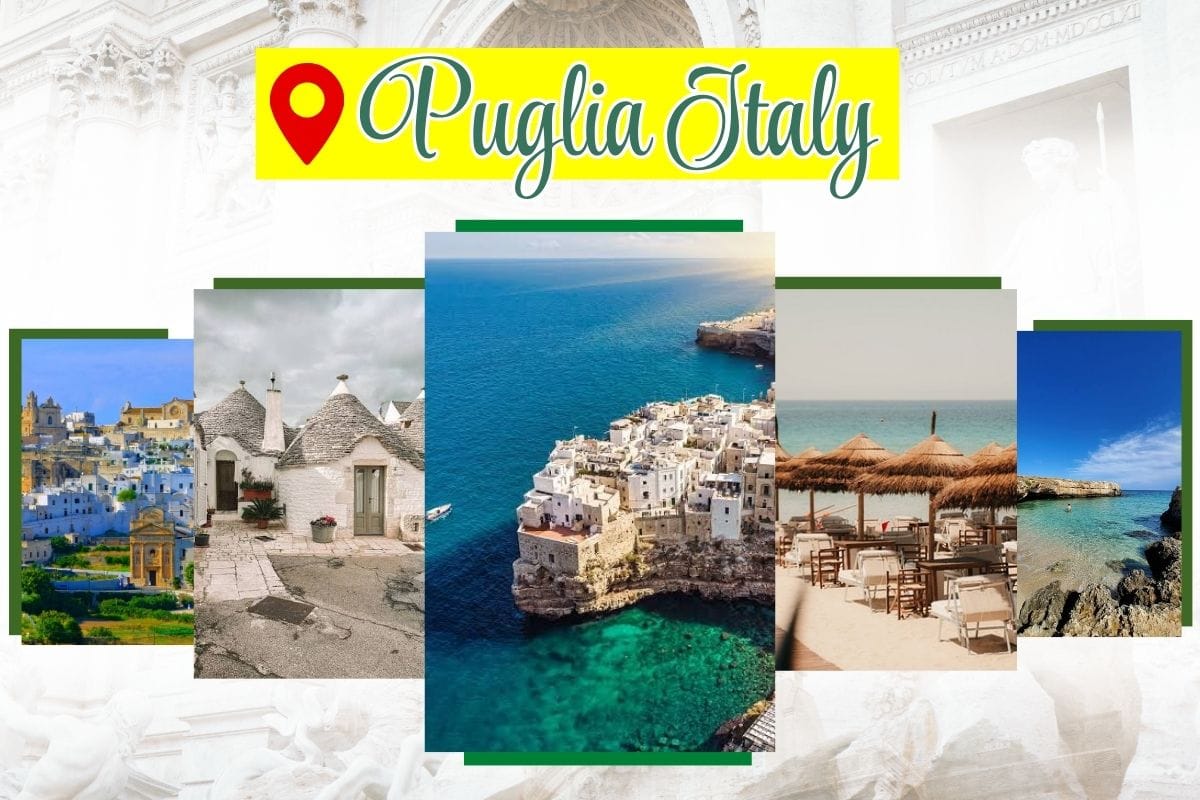
Quick Answer: Puglia, Italy, also known as Apulia, is the heel of the boot. The Adriatic is on one side, the Ionian on the other. Bari is the capital and busiest airport, and Brindisi is second. Book a car, aim for May, June, September, or October, and let the Italians have August.
Rome’s fine. Venice, sure. But while half the planet waits in line at the Trevi, Italy’s heel serves better food.
- It covers 19,345 sq km and has 3,874,166 residents in 2025.
- Longest coastline of any mainland Italian region.
- 50 to 60 million olive trees make up 40% of Italy’s olive oil.
- Two UNESCO cards: Alberobello’s trulli and Castel del Monte.
- It has hit 104°F in Lecce and Foggia, so keep that in mind.
Where is Puglia? Reading the Puglia, Italy, Map
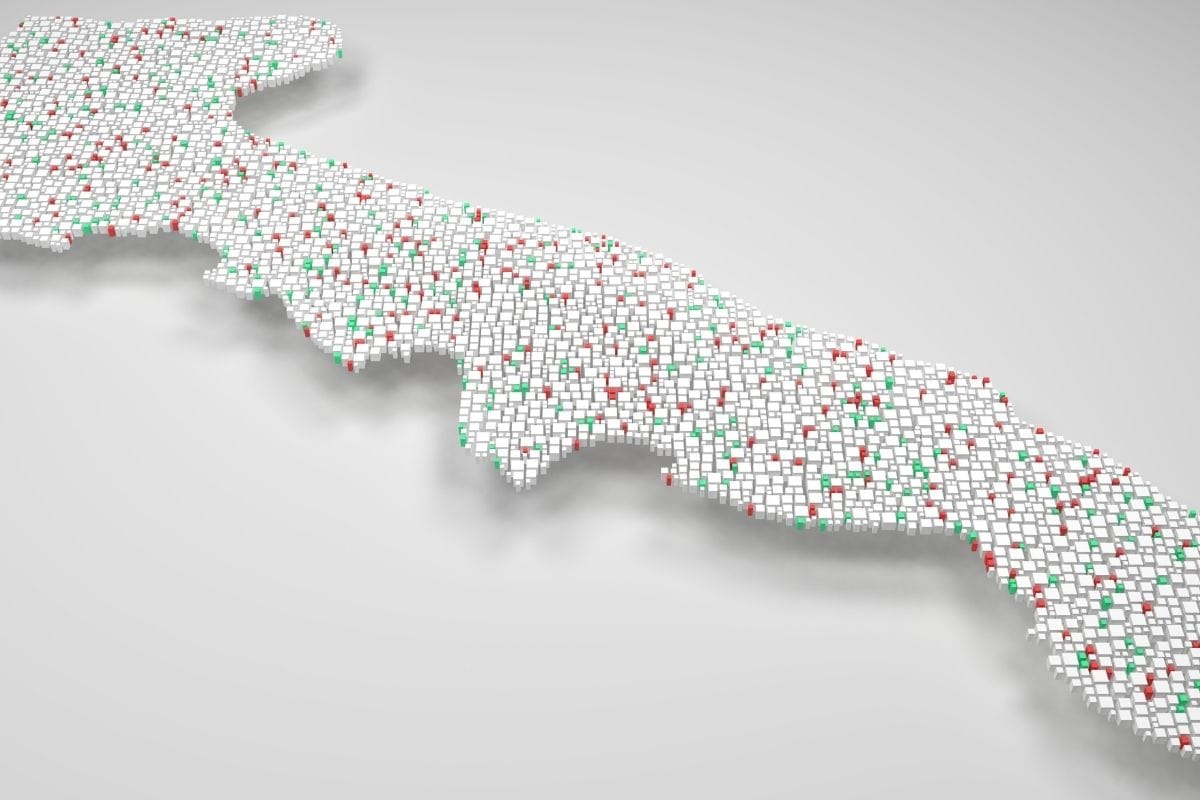
Pull up a map of Puglia, Italy. It is on the southeastern corner of Italy. On the east side, it has the Adriatic Sea. The region starts from northern Gargano down to Santa Maria di Leuca. Between them is the Murge, a limestone plateau full of caves and sinkholes, plus the Tavoliere, one of Italy’s biggest plains.
The capital of Puglia, Italy, is Bari. It has 6 provinces: Bari, Lecce, Foggia, Taranto, Barletta-Andria-Trani, and Brindisi. Wikipedia states the high point is Monte Cornacchia, 1,152 meters, in the Daunian Mountains.
Antonio Decaro has been president since January 2026. The two national parks are Gargano and Alta Murgia. In 2010, the health ministry called 98.6% of the coast clean to swim in.
A History Written by Everyone Who Passed Through
Somebody’s lived here 250,000 years. That’s how old the Altamura Man is, the Neanderthal they pulled from a cave. Greeks sailed in around the 8th century BC and founded Taras. You know it as Taranto today.
Then Rome. The Appian Way, which started in 312 BC, ran down to Brindisi, the port looking toward Greece and Egypt. You can still walk stretches.
After Rome collapsed? Essential Italy reports that Goths, Byzantines, Saracens, Normans, Aragonese, and Spanish each took a turn. Frederick II turned up in the 1200s and built Castel del Monte near Andria, 1240 to 1250, an octagon nobody can explain.
Then came the Kingdom of the Two Sicilies, unification in 1861, and Mussolini’s “Battle for Wheat,” which turned the south into one giant grain field. It is still intact and grows wheat every year.
When to Visit Puglia, Italy
| Season | Weather | Crowds | Go For |
| Spring (Apr–Jun) | 65–80°F | Light | Towns, hiking, swims |
| Summer (Jul–Aug) | Up to 104°F | Mobbed | Beaches, festivals, music |
| Fall (Sep–Oct) | 68–82°F | Medium | Warm sea, olive harvest |
| Winter (Nov–Mar) | Mild, wet | Dead quiet | Cheap rooms, Christmas markets |
It snows barely here. The last coastal dusting was in January 2019. Wind is what you notice. Bora comes down cold off the Adriatic. Sirocco blows up hot from North Africa, sometimes red with Sahara dust. You can visit during spring days and enjoy swimming at Gallipoli while Otranto zips up jackets.
Getting There and Getting Around
Two airports take the incoming: Karol Wojtyła in Bari (BRI) and Brindisi (BDS). Rental desks at both. The A14 heads north toward Bologna, and the A16 cuts west to Naples. Fast rail from Naples to Bari is due in 2027. There are trains, but they are very slow. Rural buses are also there if you love traveling by bus. At last, you can rent a car, too.
Towns and Coastline Worth Your Days
Lecce first. They call it the Florence of the South. Baroque architecture is everywhere, along with a Roman amphitheater and the Basilica di Santa Croce.
Then there is Alberobello, the trulli capital. Plum Guide explains that those cone-roofed huts date to the 14th century and were stacked dry, with no mortar, so owners could pull them apart when the taxman came sniffing.
Ostuni glows white on its hill. Polignano a Mare hangs over Lama Monachile beach. Locorotondo is a circle. Velvet Escape suggests basing in Martina Franca, since every road in the Itria Valley meets there.
More: Bari’s old town has the Basilica of Saint Nicholas and a Norman-Swabian castle. Taranto has an Aragonese castle and the Gold of Taranto. Gravina’s Roman bridge opened No Time to Die. Putignano’s Carnival dates to 1394.
Up north, Gargano National Park covers 120,000 hectares, with Foresta Umbra inside it and Vieste, Peschici, and Monte Sant’Angelo round the edges. Watch for trabucchi, wooden fishing rigs on stilts. A few serve lunch now. Take a ferry to the Tremiti Islands, San Domino and San Nicola, for diving. Matera, technically in Basilicata, is worth two nights.
Beaches, by the numbers from Apulia: 370 km of sand along a 995 km coast. Punta Prosciutto. Pescoluse, the Maldives of Salento. Baia dei Turchi. Vignanotica. Torre Guaceto is protected. One casualty: the arch at Torre Sant’Andrea collapsed in a storm in February 2026.
Food and Liquid Gold
Orecchiette with broccoli rabe is non-negotiable. In Bari’s old town, women still roll the pasta by hand outside their front doors.
After that: panzerotti, focaccia barese, friselle, bombette, fava beans with chicory, taralli, and pasticciotti leaking custard.
106,715 hectares of vines, more than any region; four DOCG labels. Ask for Primitivo di Manduria, Negroamaro or a Salento rosato. Eat burrata in Andria. Buy Altamura bread, the first in Europe to land DOP status. Taranto farms 30,000 tons of mussels a year, more than any city on earth.
Then the oil. Coratina and Ogliarola, mostly. Xylella fastidiosa has killed groves down south since around 2008, and locals will tell you about it at length.
Language, Culture and Local Faces
The language is Italian, obviously. But listen and you’ll catch Salentino, Barese, and Tarantino. There’s Griko too, an old Greek tongue a few thousand still speak, plus Arbëreshë Albanian, hanging on since refugees turned up in the 1500s. Fourteen villages made Italy’s official prettiest-villages list.
Names from round here? Domenico Modugno, who wrote “Volare.” Padre Pio. Aldo Moro. Rodolfo Valentino. Riccardo Scamarcio, Checco Zalone, sprinter Pietro Mennea, and Antonio Conte.
Where to Stay
Masserie: old fortified farmhouses, now hotels with pools, spas, and vegetable patches. Trulli rentals in the Itria Valley are available if sleeping under a stone cone appeals to you. Or grab a room in Bari, Lecce, or Ostuni. Summer books out early.
FAQs
- Is Puglia expensive compared to the rest of Italy?
Ans: Not really. Meals and rooms undercut Rome and the Amalfi Coast. The coastal areas in July and August are the most expensive.
- How many days do you need in Puglia?
Ans: Seven to ten. This is enough time to explore the Itria Valley, Lecce, and some coastal areas and take a trip to Gargano or Matera.
- Do you need a car in Puglia?
Ans: Yes. Trains skip small towns and decent beaches, and rural bus timetables are a gamble.
- What is the best month to visit Puglia?
Ans: June or September. The sea is warm, days are long, and the August crowd has gone home.
- Is Puglia safe for American travelers?
Ans: It is very safe. Low crime overall. Use your usual street sense in Bari and Taranto and you’ll be fine.
- Which airport should I fly into?
Ans: Bari for the north and Itria Valley. Brindisi if you’re heading to Salento and the southern beaches.
Sources & References:
- Wikipedia – The high point is Monte Cornacchia, 1,152 meters, in the Daunian Mountains.
- Essential Italy – Goths, Byzantines, Saracens, Normans, Aragonese, and Spanish ruled Puglia, Italy.
- Plum Guide – Cone-roofed huts date to the 14th century and were stacked dry
- Velvet Escape – Make Martina Franca your base, as every road in the Itria Valley meets there.