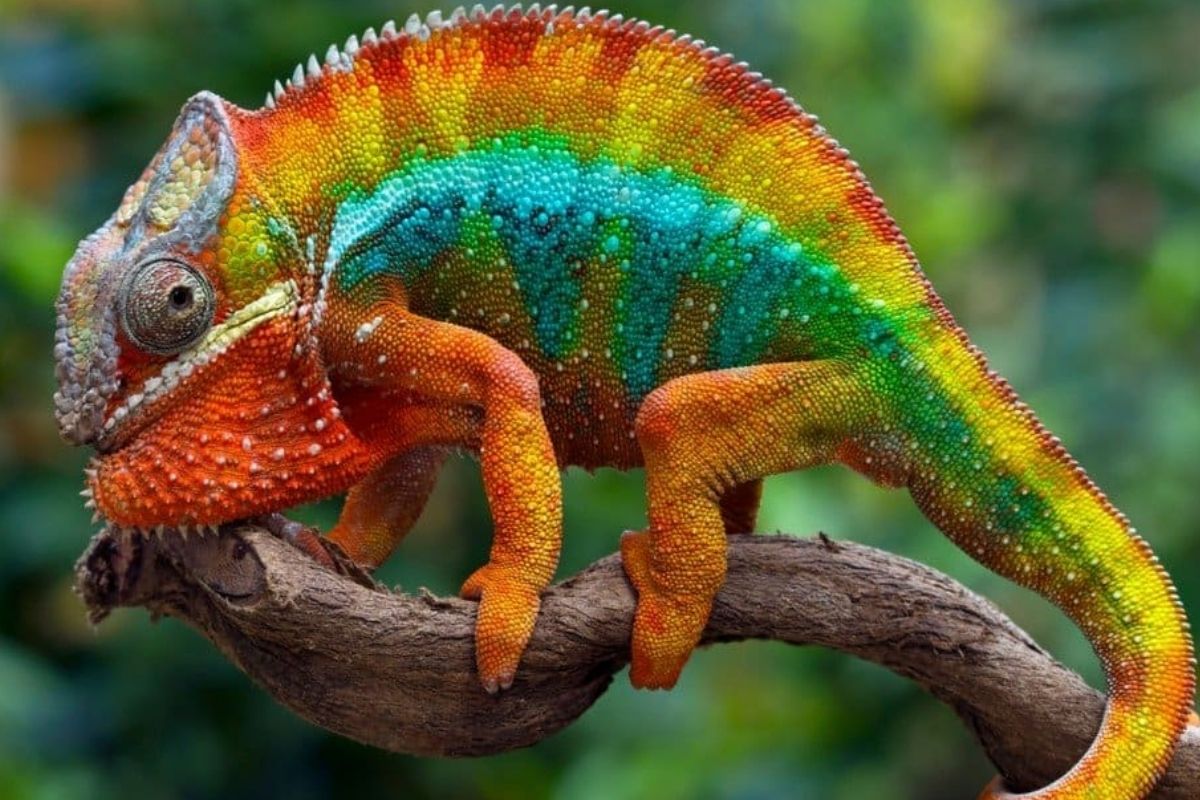
Quick Answer: Chamaeleonidae is a family of 200-plus Old World lizards that change color to show mood and manage body heat, not to match what they’re sitting on. Their eyes work separately. Their tongues are basically slingshots.
- Over 200 species. Roughly half live nowhere but Madagascar.
- Color comes from pigment cells plus tiny crystals the animal can reshape at will.
- The tongue lands in 0.07 seconds at more than 41 g.
- The smallest is under an inch. The biggest is nearly 27 inches.
- Many have bones that glow blue under UV.
- They’re reptiles; they carry Salmonella, and they’re expert-only pets.
What Makes Chamaeleonidae Different From Other Lizards
Once you’ve seen one, you can’t confuse it with anything else. The five toes on each foot fuse into two bundles, two on one side and three on the other, so each foot grips like a pair of tongs. Every toe has a claw. Arboreal species use the tail as a fifth limb.
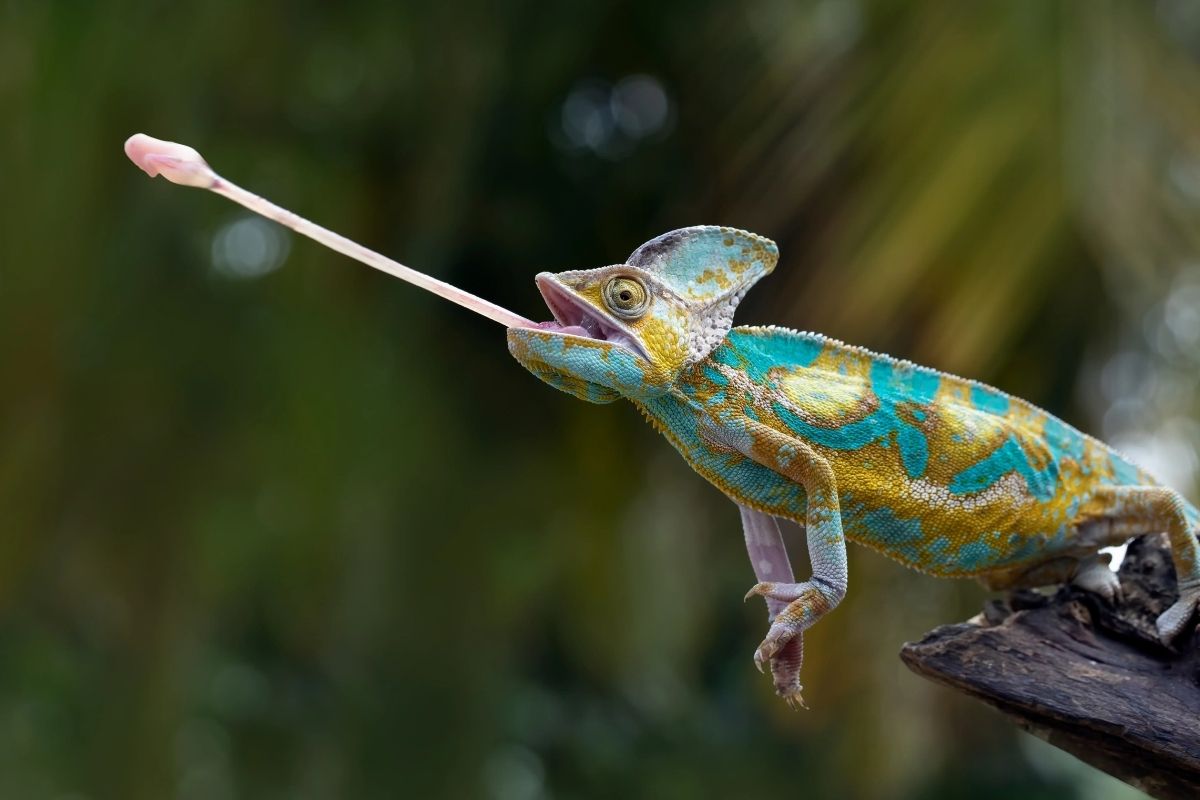
Animal Diversity Web highlights a few less obvious giveaways too: acrodont teeth welded to the jaw edge, no femoral pores, and that absurd stretchy tongue. Most also wear horns, crests, or a helmet-shaped casque. They’re slow. Top speed is around 3 mph.
The Name Means “Ground Lion”
Greek again. Chamai means “on the ground,” and Leon means “lion.” AZ Animals supports this translation, and it fits 100%. Tiny body, dragon face. Aristotle described them in History of Animals. Pliny the Elder wrote about the color shifts. Shakespeare had Hamlet joke about eating “the chameleon’s dish,” because Elizabethans thought these lizards lived on air alone.
Also Read – What Dog Has the Strongest Bite Force?
Color Change Is a Mood Ring, Not Wallpaper Paint
Put one on a red polka-dot tablecloth and nothing happens. It won’t grow spots. The San Diego Zoo Wildlife Alliance breaks the skin into four layers: the protective outer one, a yellow-and-red pigment layer, a melanin layer for browns and blacks, and a base layer that reflects white.
Wikipedia’s family overview explains that two stacked sheets of iridophore cells hold guanine nanocrystals in a lattice. The lizard stretches or tightens the gaps between those crystals. Tight gaps reflect blue, which filters through the yellow layer and looks green. Loosen them, and you get yellow, orange, or red.
Each species has a set palette and can’t leave it. Forest species run rich and colorful. Desert and savanna ones stay brown and burnt. “Bright” usually means angry or flirting. Black means stressed, beaten, or cold and trying to soak up sun. Smith’s dwarf chameleon takes it further and tunes its camouflage to whichever predator is watching, since birds and snakes don’t see the same way.
Two Eyes, Two Separate Views
Each eyelid is a cone with a pinhole for the pupil. Both eyes swivel and focus on their own, so there’s no blind spot anywhere. The brain just runs two feeds at once and switches between them. When prey shows up, both swing forward together. They judge distance with one eye at a time, not stereo vision.
They also have the best magnification per body size of any vertebrate and the densest cone cells in any retina. They see UV light, which perks up their basking and breeding.
Hearing is the one thing they’re bad at. No eardrum, no ear opening, and a range of only 200 to 600 Hz.
Also Read – What Makes Stick Insects Such Unusual Creatures in Nature?
A Tongue That Breaks Muscle Physics
The whole setup sits bunched at the back of the mouth. A bony spike called the entoglossal process runs down the middle. A ring-shaped accelerator muscle squeezes around it and loads collagen springs. Let go, and you get over 3,000 watts per kilogram. No muscle on earth makes that much power. The springs do.
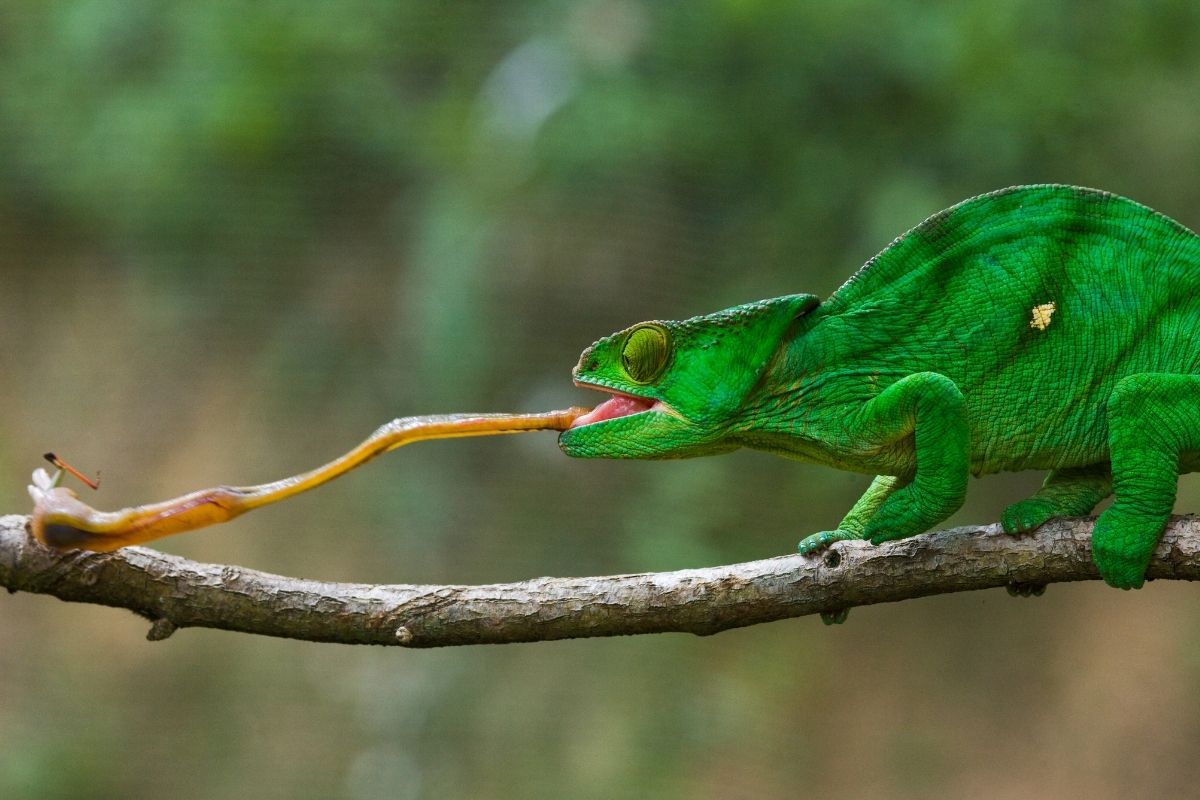
Here’s the bonus nobody expects. Springs don’t slow down in the cold, so a chilly chameleon still strikes at full speed while every lizard around it sits frozen. Small species get proportionally bigger tongue gear so they can fire more than twice their body length. The sticky tip grabs with suction and wet adhesion, then the hyoglossus muscle hauls it all back in.
Bones That Glow Blue
This is a recent find, and it’s a weird one. Many chameleons have bony bumps on the skull covered by skin thin enough to let light through. Under UV, they light up blue. CT scans turned up the pattern in 31 Calumma species from Madagascar. The best guess is a second signaling channel that doesn’t mess with their color work.
Also Read – Before You Laugh at a Fat Monkey
Is a Chameleon a Reptile or an Amphibian?
Reptile. Class Reptilia, order Squamata, same branch as snakes and geckos. Dry scales, air-breathing from day one, and shelled eggs or internal young. Amphibians need water to breed and have soft, permeable skin. Chameleons don’t.
Size Extremes and a Record-Breaking Short Life
Britannica records Parson’s chameleon as the longest at about 69.5 cm, roughly 27 inches. Oustalet’s chameleon is right behind at 68.5 cm. On the other end, a male Brookesia nana comes in at nearly 22 mm, which makes it one of the smallest reptiles alive. Most species measure only 7 to 10 inches.
Then there’s Labord’s chameleon, the holder of the shortest lifespan of any vertebrate. Hatch in November. Adult by January. Breed, lay eggs in February, and the entire adult population dies.
The family’s old, too. The oldest named fossil, Anqingosaurus brevicephalus, dates to the Middle Paleocene, around 58 to 62 million years ago.
Eggs, Live Birth, and an Old African Riddle

Most species lay eggs. The female climbs down, digs, lays, and walks away. Clutches run from two eggs in little Brookesia up to 200 in a veiled chameleon. Incubation takes four months to over a year, and Parson’s eggs can sit for 400 to 660 days. Jackson’s chameleon skips all that and gives birth to 8 to 30 live young after five or six months.
A Londolozi field note by Sean Zeederberg explains a myth about this species. Flap-necked chameleons lay 25 to 60 eggs in layers, and the whole dig can take a full day. Occasionally, it kills the mother. Nine to twelve months later, the babies hatch and climb out through the mother’s skeleton. Hence the old story that chameleon bones turn into baby chameleons.
Is Chameleon Good or Bad Luck?
Depends on who you ask. Science says neither. Folklore has opinions. In Zulu tradition, a chameleon was sent to tell people they’d never die, got distracted eating ubukhwebezana berries, and a lizard beat it with the opposite message.
In Kenya and Uganda, the sideways walk is considered witchcraft. South Africans have used them to predict weather. Nigerian lore warns against letting a baby touch one. In Madagascar, they appear in regional fady and local taboos.
Also Read – Before You Laugh at a Fat Monkey, Here’s What to Know
Can Chameleons Be Kept As Pets?
Yes, if you’re realistic. Bill Strand of the Chameleon Academy says it straight: a chameleon is a pet you watch, not one you hold. They don’t bond. Handling stresses them out. Setup costs $300 to $1,500, and you’ll be raising and gut-loading live bugs for the rest of their lives.
WebMD warns about the health side. These lizards carry Salmonella, and nobody under five should touch one. Poor care brings metabolic bone disease, egg retention, and gout. Never house two together. All of Chamaeleonidae sit on CITES Appendix II, so check the paperwork.
Why They Need Protecting
Madagascar holds close to two-thirds of all chameleon species, and its forests are going fast to slash-and-burn farming, charcoal logging, and cattle. The Belalanda chameleon, the bizarre-nosed chameleon, and the Namoroka leaf chameleon are already at critical risk. Many more are data-deficient, meaning we might lose them before we understand them.
FAQs
- Why do chameleons really change color?
Ans: Mainly to talk to each other and control body temperature. Bright shades signal aggression or courtship, dark ones signal stress or soak up heat. Camouflage is a side benefit.
- How many species are in Chamaeleonidae?
Ans: More than 200, across about a dozen genera. Roughly half are found only in Madagascar, with most of the rest spread across sub-Saharan Africa.
- How fast is a chameleon’s tongue?
Ans: It reaches prey in about 0.07 seconds at over 41 g. Elastic tissue supplies the power, not muscle, so it stays fast even on cold mornings.
- Can chameleons really see 360 degrees?
Ans: Yes. Each eye moves and focuses independently, covering everything around the body. Both eyes lock forward only when the chameleon is lining up a strike.
- Do chameleons bite people?
Ans: Rarely, and it barely hurts. They bite when handled or stressed. The real risk is Salmonella, so wash your hands after any contact.
- Which chameleon is the smallest?
Ans: Brookesia nana, the nano-chameleon from Madagascar. Males measure around 22 mm total, putting them among the smallest reptiles ever recorded.
Sources & References:
- Wikipedia – Two stacked sheets of iridophore cells hold guanine nanocrystals in a lattice.
- Britannica – Parson’s chameleon is the longest at about 69.5 cm, roughly 27 inches.
- San Diego Zoo – Its skin has four layers.
- AZ Animals – Chamai means “on the ground”, and Leon means “lion”.