Quick Answer: B vitamins are eight water-soluble nutrients your body needs almost daily. The vitamin B health benefits are that it extracts energy out of your food, builds red blood cells, stops your nerves from malfunctioning, and slashes the odds of birth defects. Eat a normal diet and you will get all the vitamins your body needs.
- Eight vitamins form the B complex: B1, B2, B3, B5, B6, B7, B9, and B12.
- Your body accumulates almost none. Only B12 and folate are in the liver.
- Heat, processing, and booze destroy them.
- Eat a bad diet for a few months and you will find yourself low on vitamins.
- Never self-diagnose a deficiency. Some B vitamins get toxic fast.
What Vitamin B Actually Is
Thirteen vitamins keep you alive. Eight of them have the letter B and each helps enzymes work inside your cells.
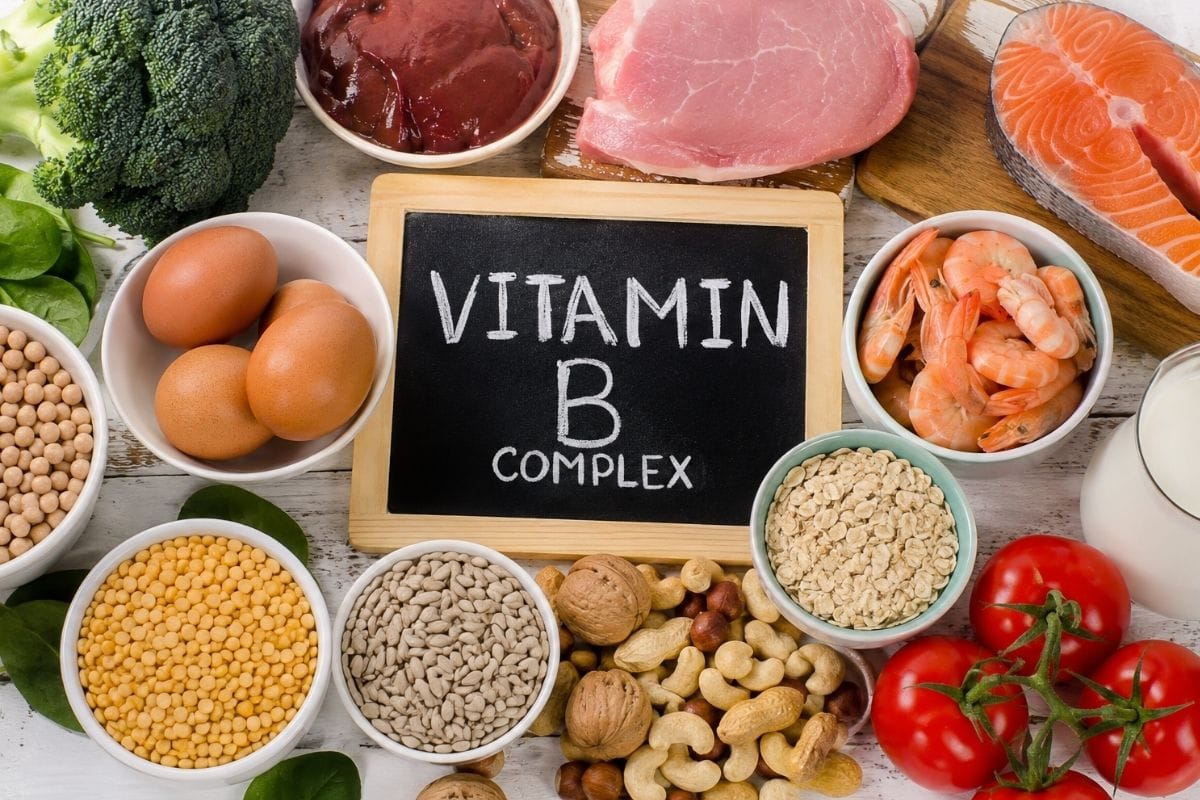
Now, the lie you’ve been sold. B vitamins do not give you energy. Not a drop. Better Health Channel has called out supplement ads over these claims for years. What they actually do is unlock the energy already in your carbs, fat, and protein. A few also help cells copy DNA.
They’re sensitive. Heat kills them in food. So does booze. Processing yanks them out, which is why white bread, flour, and rice are kept at the kids’ table beside wholegrain. Our bodies don’t store them. Because it is water-soluble, some of it leaves in your pee.
8 Types of Vitamin B
| Vitamin | Also called | Function | Daily Value |
| B1 | Thiamin | Glucose to energy, nerves | 1.2 mg |
| B2 | Riboflavin | Energy release, vision, skin | 1.3 mg |
| B3 | Niacin | Skin, digestion, nerves | 16 mg |
| B5 | Pantothenic acid | Fats, red cells, hormones | 5 mg |
| B6 | Pyridoxine | Amino acids, brain, immunity | 1.7 mg |
| B7 | Biotin | Breaks down fat and protein | 30 mcg |
| B9 | Folate | Red cells, DNA, fetal growth | 400 mcg |
| B12 | Cobalamin | Myelin, red cells, nerves | 2.4 mcg |
Niacin is the most complicated vitamin. It’s heat resistant, so cooking barely breaks it. It morphs into NAD, a coenzyme driving more than 400 enzyme reactions. B6 runs over 100. And B12 is the only vitamin with a mineral inside: cobalt.
Where to Find Vitamin B in Food
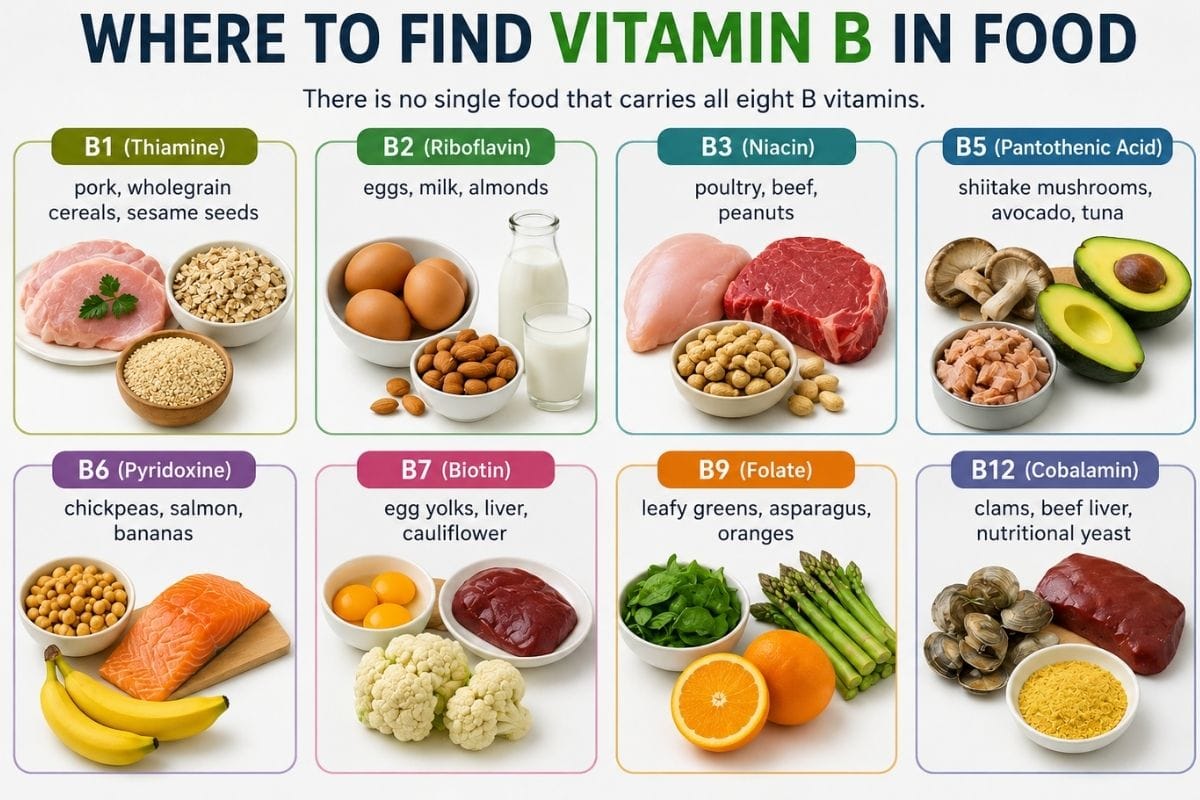
There is no single food that carries all eight B vitamins. The sources of food are:
- B1: pork, wholegrain cereals, sesame seeds
- B2: eggs, milk, almonds
- B3: poultry, beef, peanuts
- B5: shiitake mushrooms, avocado, tuna
- B6: chickpeas, salmon, bananas
- B7: egg yolks, liver, cauliflower
- B9: leafy greens, asparagus, oranges
- B12: clams, beef liver, nutritional yeast
If you’re a vegan, then keep in mind that B12 is from animal products. Fortified cereal or a supplement is also a good source. The FDA makes firms add folic acid to enriched bread, pasta, and rice.
Vitamin B Health Benefits Worth Knowing
It prevents anemia: Anemia affects an estimated three million people in the United States. If you have low B12, your body can’t make enough red blood cells, and you feel fatigue and have tingling feet.
Supports your heart: B6, B9, and B12 reduce homocysteine, a leftover of protein breakdown. A 2024 systematic review and meta-analysis in China of more than 76,000 people found folic acid combined with vitamin B12 and vitamin B6 supplementation significantly reduced the risk of stroke. Then again, old research on more than 8,000 people found no benefit over placebo.
Saves your memory: One meta-analysis of 95 studies concluded that taking vitamin B supplements reduced cognitive decline, and lower levels of folate were associated with a higher risk of dementia.
Beats migraines: About 400 mg intake of riboflavin daily cuts how often attacks land and how long they hang around. The theory: it fixes how brain cells make energy. Give strength to your immune system. B6 builds antibodies, white cells, and T cells. Riboflavin brings antioxidant muscle against free radicals.
Help babies develop: Folic acid stops neural tube defects like spina bifida and anencephaly. The CDC wants 400 mcg daily for women of reproductive age, 600 mcg in pregnancy, and 500 mcg while breastfeeding.
Improves skin: Niacinamide, the cream form of B3, rebuilds the skin barrier and cools inflammation. Acne, eczema, and rosacea settle down. WebMD adds that nicotinamide supplements reduce the risk of non-melanoma skin cancer.
Heals mouth ulcers: A meta-analysis of more than 1,500 patients found B-complex supplements sped healing by roughly two days.
Steadies hormones: B5 feeds your adrenal glands, small organs that make cortisol and sex hormones. B12 and folate run methylation to turn genes on and off.
Signs of Vitamin B Deficiency

There’s no particular “B complex deficiency,” as Medical News Today points out. Symptoms depend on which vitamin runs low.
- B1: confusion, wobbly balance, weak muscles. Severe cases bring beriberi, wet or dry, or Wernicke-Korsakoff syndrome.
- B2: cracked lips, sores at mouth corners, hair loss.
- B3: pellagra, the three Ds—dementia, diarrhea, and dermatitis. It kills untreated.
- B5: burning hands and feet, headache, restlessness. Very rare.
- B6: anemia, swollen tongue, scaly rash, low mood.
- B7: thinning hair, brittle nails, scaly rash. Months of raw egg whites trigger it.
- B9: fatigue, palpitations, mouth sores.
- B12: numbness, memory loss, megaloblastic anemia.
Heavy drinking kills the vitamins. It blocks thiamin in your gut and makes kidneys flush it faster. B12 absorption fades with age.
Side Effects You Should Not Ignore
Water-soluble doesn’t mean they are risk-free. Healthline warns that mega-dosing single B vitamins carries real risk.
- Too much B6 causes peripheral neuropathy, that dead feeling in hands and feet.
- Too much niacin brings flushing, itching, nausea, gout, and liver damage.
- Over 1,000 mcg of folic acid daily masks a B12 shortage while damaging nerves.
- Some studies tie heavy B12 intake to lung cancer, smokers especially.
Biotin exists in every hair-and-nails gummy. The NIH says the proof isn’t there.
Do You Need a Supplement?

Probably not. Most people get the full vitamin B health benefits from food, where these vitamins arrive bundled. Everyday Health suggests a full B complex over single vitamins, since hammering one throws the rest off.
You might need help if you’re over 50, pregnant, vegan, on heartburn meds, or living with Crohn’s, celiac, or IBD. Weight loss surgery slashes absorption. And no, B12 shots won’t melt fat. Never proven in humans.
Ask your doctor. Supplements aren’t safety-checked before sale.
FAQs
- What is vitamin B good for?
Ans: It pulls energy from food, builds red blood cells and keeps nerves healthy. It also supports skin, brain, and immunity.
- Which foods have the most vitamin B?
Ans: Beef liver, clams, salmon, eggs, dairy, leafy greens, and fortified cereals.
- Is it safe to take a B complex daily?
Ans: For most healthy adults, yes. Your body dumps the extra. Still, read the label and ask your doctor.
- Can vitamin B help you lose weight?
Ans: There is no proof. However, it is being said that it keeps metabolism ticking but won’t burn fat for you.
- Is B12 better than a B complex?
Ans: It depends on your blood work. If you’re low on B12, just take B12. If other vitamins are also low, go complex.
- Why is my pee bright yellow?
Ans: Extra riboflavin does that. It is harmless and just means your body is clearing the excess.
Sources & References:
- Better Health – B vitamins do not give you energy.
- Medical News Today – Symptoms of vitamin B deficiency depend on which vitamin runs low.
- Everyday Health – An A B complex intake over single vitamins can hammer one and throw the rest of the chart.
- WebMD – Nicotinamide supplements reduce the risk of non-melanoma skin cancer.
Note – Studies have investigated whether B vitamins, particularly folate, B6 and B12, may influence stroke risk through their relationship with homocysteine levels. However, this does not mean that taking B-vitamin supplements prevents stroke.