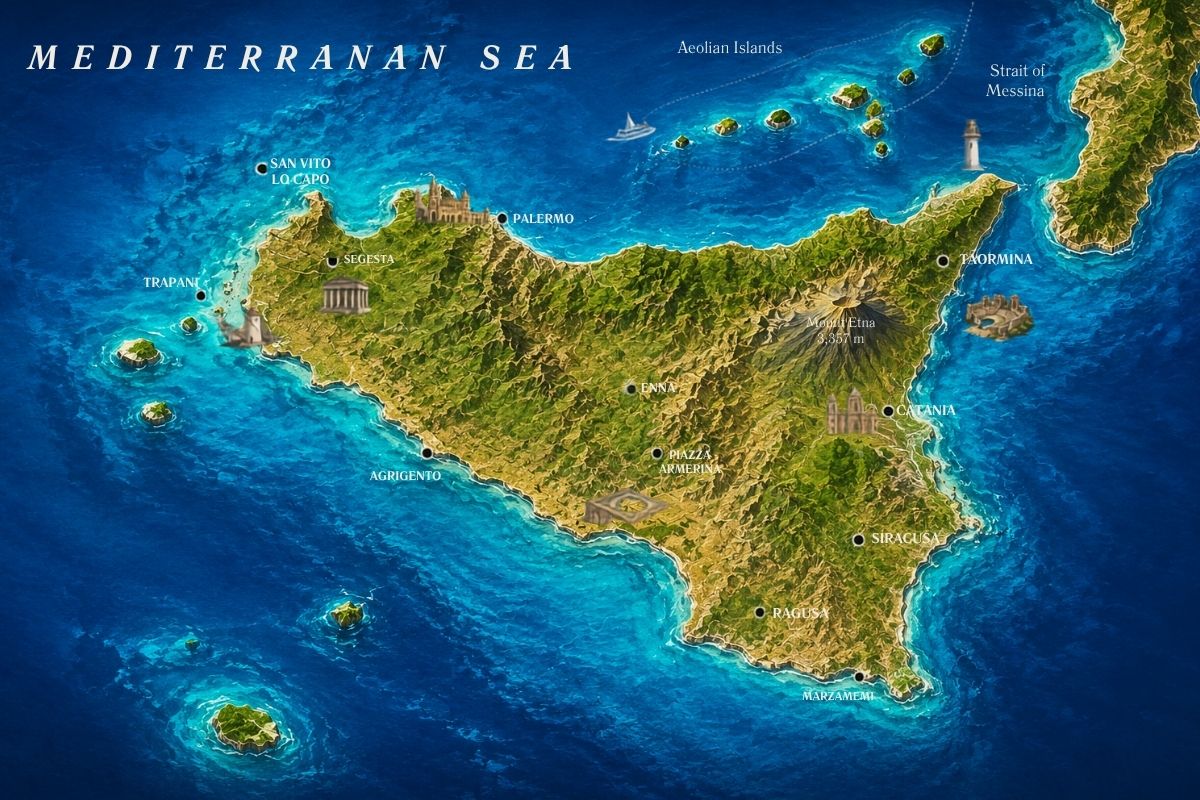
Forget the postcard. The Mediterranean Sea, Sicily, Italy version they sell you: blue water, a slice of lemon, and somebody on a Vespa. It is true, but it’s the trailer, not the movie.
The real thing? A smoking volcano. Greek temples are older than Roman temples. A flag with three legs. And the food is so good that they literally nicknamed the place “God’s Kitchen”.
- Sicily is the biggest island in the Mediterranean, smack in the center.
- Mount Etna, Europe’s tallest active volcano, basically never stops grumbling.
- Greeks, Arabs, Romans, Normans, and Spanish: everyone took a turn ruling it.
- Seven UNESCO World Heritage Sites. On one island.
- The food alone is worth the flight.
A Quick Lay of the Land
Let’s settle the “how big is Sicily” question right away: about 25,711 square kilometers. That makes it the largest island in Italy and the biggest island in the Mediterranean, hands down.
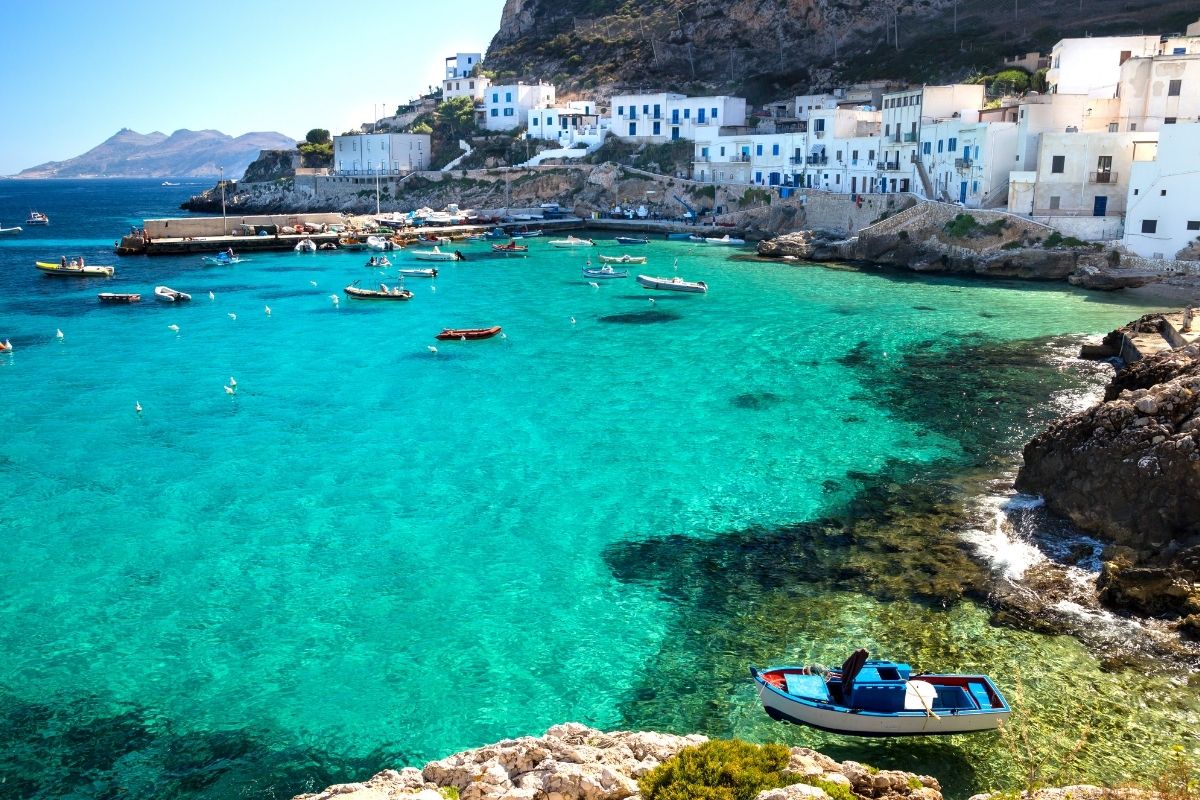
It’s one of Italy’s twenty regions, but it’s got autonomous status, its own government, and a serious independent streak. Tibi Lint In Nature says it can feel like a separate country altogether, and honestly, it does.
It hangs off Italy’s toe, divided from the mainland by the skinny Strait of Messina, just 3 km across at its north. Drive on via the ferry from San Giovanni to Messina, and you’re in. Roughly 4.7 million people live here, around 1.2 million of them crowded into Greater Palermo, the capital.
Also Read – Italy’s Biggest Cultural Events To Watch Out For In 2026
Why Does Everyone Want to Visit Sicily?
The Educated Traveller drops this perfect line from a Ragusa guide: “Believe me, Janet, nobody passed us by, nobody.” The Greeks built temples to rival Athens. Romans turned the island into their grain basket, shipping wheat straight to Ostia.
Arabs rolled in around 827, bringing lemons, oranges, sugarcane, and irrigation smarts. Then the Normans took Palermo in 1071 and built those gobsmacking gold-mosaic churches.
The Black Death? It first hit Europe right here, in Messina, in October 1347. The 1908 Messina earthquake killed more than 80,000. And yes, this is the birthplace of the Mafia, Cosa Nostra, which the Easy Conferences crowd will tell you about alongside the prettier stuff.
The Big-Ticket Sicily Attractions
Mount Etna’s the headliner. It is 3,403 meters tall, the highest mountain in Italy south of the Alps, and it is constantly doing something dramatic. Hike it north or south. Then the ruins. The Valley of the Temples in Agrigento is Greek architecture at its finest.
Villa Romana del Casale near Piazza Armerina holds the richest, largest, and most complex collection of Roman mosaics in the world. Syracuse and its little island of Ortigia gave us Archimedes. Baroque obsessives get Noto, Modica, and Ragusa. Beach people get Cefalù and Taormina, that cliff-top stunner with a Greek theater framing Etna.
Also Read – Italy’s Forgotten Villages
Why Is Sicily So Important in the Mediterranean Sea?
Short answer: Sicily sits in a strategically important position in the Mediterranean, which is one reason the island has been influenced by so many different civilisations.
Its location between Europe and North Africa made Sicily an important point for trade, military expansion, and cultural exchange. Greeks, Romans, Arabs, Normans, and Spanish rulers all left their mark on the island.
Money, Salt, and Silicon
It’s not all temples and tans. As per Wikipedia, Sicily is Italy’s eighth-largest regional economy, though GDP per capita sits below the national average, and unemployment has been stubbornly high, around 21.5% back in 2018.
The land’s the real wealth: volcanic soil grows wheat, blood oranges, lemons, olives, almonds, pistachios from Bronte, and grapes. It’s Italy’s third-biggest wine producer, famous for fortified Marsala and the great red Nero d’Avola.
There’s grit, too. Etna Valley near Catania is a legit electronics hub; STMicroelectronics has factories there. Syracuse has petrochemicals, Palermo has shipyards, and Trapani is one of Italy’s biggest sea-salt producers. Fishing’s huge, with Mazara del Vallo leading the tuna and swordfish hauls.
Tourism and Transportation
Tourism is a major earner, and the region is pouring money into hotels to attract even more visitors. Catania-Fontanarossa is the busiest airport. Palermo is also busy.
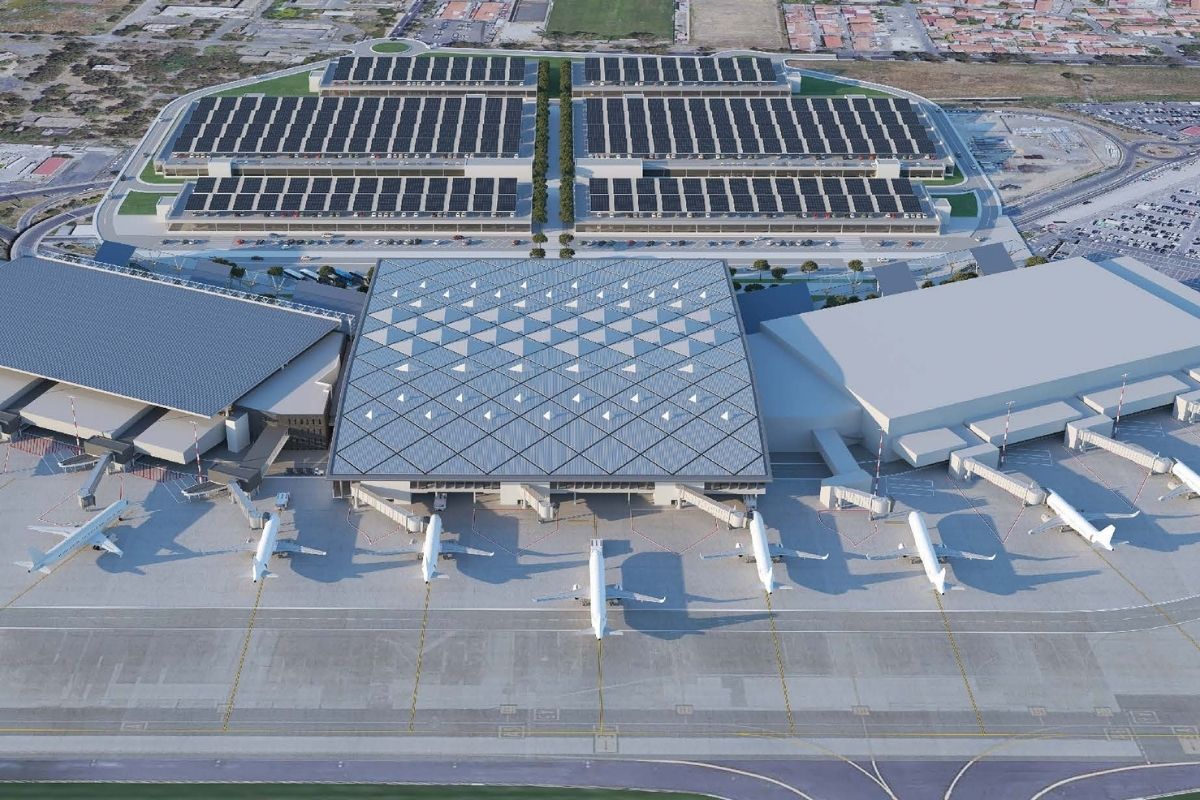
Trains loop the coast, ferries link every corner, and a famous proposed Strait of Messina Bridge, 3.6 km long, is finally moving, approved in 2025, and set to open in 2032 as the world’s longest suspension bridge. They’ve been arguing about it since ancient times, so don’t hold your breath.
God’s Kitchen
The food deserves a sonnet. It’s Mediterranean, but spiked with Greek, Arab, Spanish, and Jewish flavors. Sicilians have a legendary sweet tooth. Some of the best dessert-makers in Italy. Cannoli (crispy shells, sweet ricotta). Granita (icy, real crushed fruit).
Cassata, the Arab-inspired cake. Arancini, those fried rice balls that are basically the national snack. Pasta alla Norma. And in Trapani, North African couscous shows up. Wine flows everywhere, yet Sicily has the lowest rate of alcoholism in all of Italy. Go figure.
Also Read – 8 Famous Landmarks to See
Three Legs and a Sonnet
The culture runs deep. Pirandello and Quasimodo both won the Nobel Prize. Giacomo da Lentini, a Sicilian, basically invented the sonnet. The Opera dei Pupi puppet theater is a UNESCO treasure.
As Goethe put it, “To have seen Italy without having seen Sicily is to not have seen Italy at all, for Sicily is the clue to everything.” And that three-legged triskelion flag? It was first flown in 1282 after the Sicilian Vespers.
Go in spring or fall. Rent a car (the driving is crazy, and you should bring cash). And don’t rush it.
FAQs
- Is Sicily part of Italy?
Ans: Yes, it’s one of Italy’s twenty regions, but with special autonomous status and its own regional government.
- What is Sicily best known for?
Ans: Mount Etna, ancient Greek and Roman ruins, Baroque towns, beaches, and unreal food like cannoli, arancini, and cassata.
- How do you get to Sicily?
Ans: Fly into Catania or Palermo, or take a ferry across the Strait of Messina from the mainland.
- What language do they speak in Sicily?
Ans: Sicilian, its own Romance language, has about 30% of its vocabulary coming from Arabic. Most locals speak Italian too.
- What is the capital of Sicily?
Ans: Palermo, also the largest city, has roughly 1.2 million people across its metro area.
- When is the best time to visit Sicily?
Ans: Spring or fall for ideal weather. Summer’s hot and crowded; winter gets cold up in the mountains.
Sources & References:
- Wikipedia – Sicily is Italy’s eighth-largest regional economy.
- Easy Conferences – Sicily is the birthplace of the Mafia and Cosa Nostra.
- Tibi Lost in Nature – Sicily feels like a separate country in itself.
- The Educated Traveller – Greeks, Romans, Athenians, Arabs, and Normans have all attacked Sicily.
Note – This guide is for travellers who want to understand what makes Sicily different from other Italian destinations before planning a trip. It is particularly useful for first-time visitors, history lovers, food enthusiasts, couples, families and travellers deciding whether to focus on beaches, ancient sites, cities or Mount Etna.