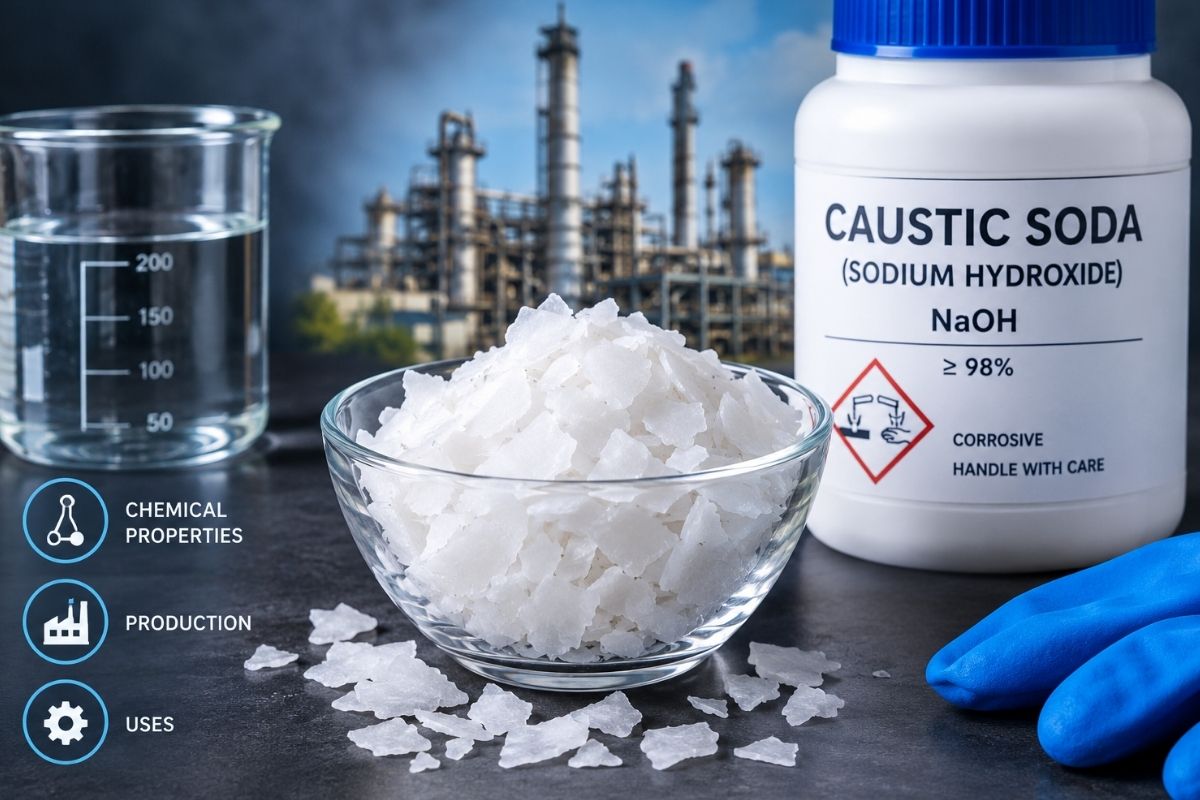
Quick Answer: Caustic soda is sodium hydroxide, NaOH. It is white and odorless. Plants make it by passing electricity through salt water. It’s used in soap, printer paper, soda cans, and drain openers. It is a strong alkali, with a pH near 14, and it burns skin on contact.
- It is known as caustic soda, lye, and sodium hydroxide. NaOH CAS 1310-73-2) has a molar mass of about 40 g/mol.
- In 2022, world output was about 83 million dry tonnes, while demand was near 51 million.
- It is never made alone. One tonne of chlorine drags about 1.1 tonnes of caustic along.
- Chemical manufacturing swallows 56%. Pulp and paper grabs 25%.
- Caustic is mixed with water. Water is never mixed with caustic. If it does, water releases heat.
What is Caustic Soda?
Caustic soda is an inorganic ionic compound made of sodium ions and hydroxide ions. “Caustic” means it burns, and it used to come from soda ash. Wikipedia lists it under soda lye, white caustic, and food additive E524.
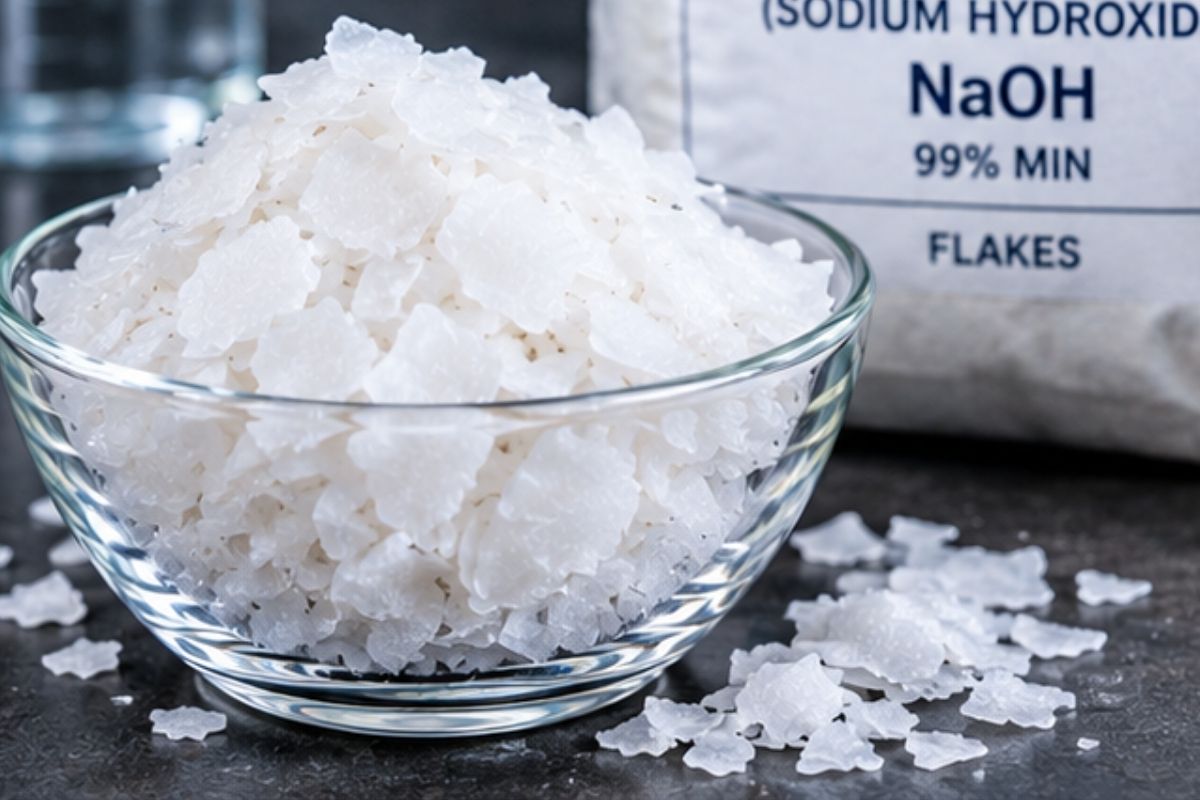
Alliance Chemical points out that “lye” isn’t a real chemical ID, because soap suppliers sometimes name it potassium hydroxide instead. So read the formula carefully.
Pure caustic soda looks like a white, odorless solid. ThoughtCo describes how its waxy form pulls water right out of the air, which is why the bag you buy is usually monohydrate, NaOH·H₂O, the form that crystallizes between 12.3 °C and 61.8 °C.
| Property | Value |
| Formula | NaOH |
| Molar mass | 39.997 g/mol |
| Melting point | ~318 °C (604 °F) |
| Boiling point | 1,388 °C (2,530 °F) |
| Solubility | 418 g/L at 0 °C, 1,000 g/L at 25 °C, 3,370 g/L at 100 °C |
| Density (solid) | 2.13 g/cm³ |
| UN number | 1823 solid, 1824 solution |
| Hazard class | Class 8, PG II |
Water, glycerol, methanol, and ethanol: it dissolves in all of them. But not in Ether.
Drop flakes in water and the beaker gets very hot. It gets hot enough to splash and to ignite something flammable placed nearby. The 50% liquid is thick too, about 78 mPa·s, next to water’s 1.0. Think olive oil.
Now, the behavior that ruins equipment. It neutralizes acids and throws off heat in the process. It scrubs sulfur dioxide from flue gas. It rips fats apart through saponification, which is the reason it both makes soap and melts grease. Touch a solution bare-handed, and it feels soapy. Don’t test the limits.
Glass? Slowly etched, and ground joints freeze solid. Aluminum, zinc, tin, and galvanized steel? Eaten, with hydrogen gas pouring off. In 1986 a UK road tanker got filled with 25% caustic by mistake, and the hydrogen pressurized the thing. Pour it into metal solutions, and you get colored hydroxides dropping out: copper blue, iron(II) green, and iron(III) yellow-brown.
How Caustic Soda is Produced
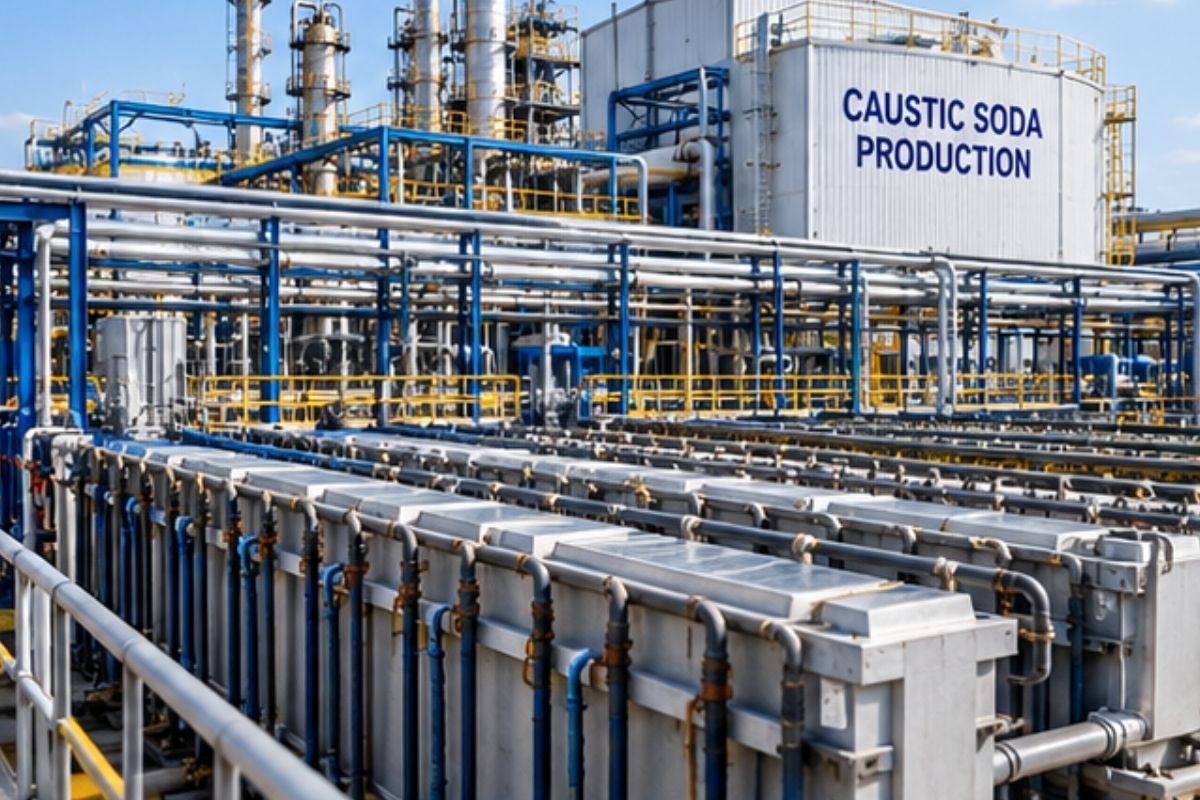
Nearly all of it comes from the chlor-alkali process, the electrolysis of brine:
2 NaCl + 2 H₂O → Cl₂ + H₂ + 2 NaOH
Euro Chlor states that an anode and cathode are put in brine, with a membrane or diaphragm wedged between them so chlorine and caustic never meet. Europe cranks out around 8 million tonnes a year with this process.
The ratio is welded shut by atomic mass: one tonne of chlorine, 1.1 tonnes of caustic, and 0.03 tonnes of hydrogen. The trade calls this an ECU, short for electrochemical unit. You can’t adjust it. So when chlorine demand tanks, cells slow down, and caustic gets scarce, even though nobody stopped buying it. Your invoice is really tracking chlorine.
Plants pull out a 32% solution, then evaporate it to 50%. Solids ship as flakes, prills, and cast blocks. Olin runs the biggest US operation at around 5.7 million tonnes yearly, with Oxychem, Westlake, Shintech, and Formosa trailing. America made 11.63 million metric tons in 2019.
The ancestor method was causticizing: lime met soda ash, chalk fell out, and caustic stayed dissolved. That soda ash came from the Leblanc process, later Solvay. Electrolysis buried both.
Forms, Grades, and Concentrations
| Form or strength | Where it lands |
| Flakes, pellets (98–99%) | Soap making, batch makeup |
| 5–10% | pH tweaks, mild cleaning, labs |
| 15–20% | CIP cleaning, wastewater pH |
| 25–30% | Parts washing, scrubbers |
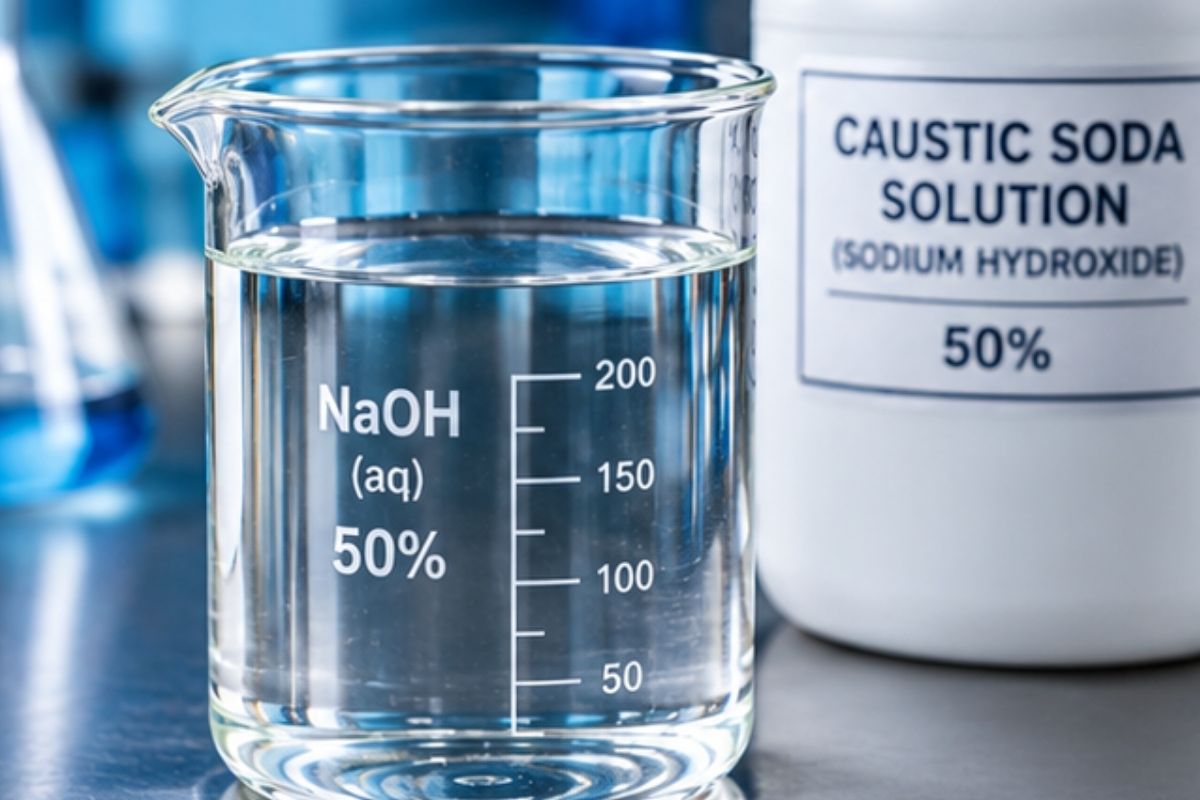
| 50% | Bulk feed, you dilute yourself |
Grades are a separate call. Technical handles cleaning and wastewater. The ACS reagent belongs in QC. Membrane grade, scrubbed of chloride and metals, goes where contamination wrecks a batch. Retail lye runs $7 to $9 a pound; bulk 50% liquid sits nearer $400 to $600 a ton. Overbuying grade is just a waste of money.
What Caustic Soda is Used For
Chemical synthesis is the biggest outlet. It makes bleach, soda ash, sodium phosphate, and hundreds of intermediates. Drug plants need it for aspirin, anticoagulants, and cholesterol medication.
Paper’s next in line. The kraft process pairs caustic with sodium sulfide to strip lignin off cellulose, then calls it back for bleaching stages demanding pH above 10.5. A single mill can burn 50 to 100 tons a day. Recyclers use it to lift ink off old sheets.
Scimplify states that it is used in water and wastewater treatment for acidity and heavy metals, cotton mercerization for stronger fiber and better dye grip, and refining, where caustic washing yanks out sulfur compounds. Drillers also dose it into mud to raise alkalinity and kill sour gas.
Bauxite gets the same treatment. Hot caustic dissolves the alumina and leaves red mud sitting there. That alumina turns into foil, cans, beer kegs, and aircraft parts.
Chandra Asri Group covers your cupboard: drain openers, oven crust remover, paint stripper, soap, detergent, and cosmetics like hair color, hairspray, and face wash, where a whisper of it just steadies pH. Add fuel cells, epoxy resin for wind turbines, rayon, spandex, explosives, ceramics, and biodiesel, where anhydrous caustic catalyzes transesterification. Salon relaxers still use NaOH, mostly in professional hands now.
Making soap? Cold process recipes use about 6% sodium hydroxide by total weight. Bars need NaOH; liquid soap needs KOH, and you’d want about 1.40 times the mass for equal punch. Let bars firm up 24 to 48 hours, then cure four to six weeks. Done right, zero free lye remains.
Caustic Soda in Food
Yes, really. The FDA treats food-grade sodium hydroxide as GRAS at proper concentrations with a thorough rinse. It peels tomatoes and potatoes for canning, processes cocoa, builds caramel color, scalds poultry, and thickens ice cream.
That glossy mahogany pretzel crust? Lye bath. Same for German lye rolls and bagels. Then there are hominy and masa, Chinese mooncake crusts, yellow alkaline noodles, century eggs, cured olives, and Norwegian lutefisk.
Side Effects and Safety
Elchemy explains that caustic soda dissolves protein and fat at room temperature. A few drops burn, and the burn keeps going deeper for hours. Eyes are worse. It penetrates in seconds, and blindness is on the table.
The exposure guidance from the UK Health Security Agency runs through inhalation: irritated eyes, nose, and throat, cough, chest tightness, headache, fever, and confusion. Fluid can collect in the lungs and may take 36 hours to show up. Swallowing it torches the mouth, throat, and stomach. It isn’t thought to cause cancer.
Flush skin or eyes with lukewarm water for a full 15 minutes, then get a doctor. Don’t make someone vomit. Don’t reach for vinegar to “cancel it out.” OSHA holds workplace air at 2 mg/m³, and NIOSH marks 10 mg/m³ as immediately dangerous.
Gloves past the wrist, splash goggles, apron, closed shoes, and open windows. Stir with a wooden spoon. Never use your hand, gloved or not.
Storage and Handling
Sealed, labeled, cool, dry, and nowhere near kids, pets, or groceries. Household lye fades in about a year as air turns it to carbonate. Friendly materials: HDPE, polypropylene, PVC, carbon steel, 304 and 316 stainless, lined fiberglass. Aluminum, zinc, brass, and glass are off the list.
Cold weather bites. The 50% liquid starts crystallizing near 12 °C (54 °F), so outdoor tanks need trace heat or you buy a weaker strength. Spills neutralize quickly and don’t pile up, though fish start suffering around 20 to 200 mg/L.
A Short History
Soap makers made it first. A recipe is written in the late 13th-century Arabic book, Al-mukhtara’ fi funun min al-suna’, compiled by al-Muzaffar Yusuf ibn ‘Umar ibn ‘Ali ibn Rasul, a king of Yemen. Water went through plant ash and quicklime until lye dripped out. Nicolas Leblanc patented factory soda ash in 1791. Brine electrolysis took the crown by the 20th century.
FAQs
- Is caustic soda the same as sodium hydroxide?
Ans: Yes, it is the same thing. Caustic soda is the industrial name, sodium hydroxide the chemical one, and lye the kitchen one.
- Is caustic soda the same as baking soda?
Ans: Not even close. Baking soda is sodium bicarbonate, mild and edible. Caustic soda burns tissue.
- Can I pour caustic soda down my drain?
Ans: You can. Quarter cup, wait 15 minutes, and flush with hot water. Keep it away from aluminum pipes.
- Why does caustic soda ship as a 50% liquid?
Ans: Fifty percent balances shipping cost against viscosity and handling. It skips dust and dissolves instantly, but it needs heated storage in cold climates.
- Is caustic soda safe in soap and cosmetics?
Ans: Once reacted, yes. Cured soap carries no free lye, and cosmetics use trace amounts purely for pH.
- Where can I buy caustic soda?
Ans: Hardware stores sell it as drain cleaner. Soap, candle, and biodiesel suppliers stock 99% pure lye. For food use, buy food-grade only.
Sources & References:
- Wikipedia – It is also known as soda lye, white caustic, and food additive E524.
- ThoughtCo. – Its waxy form pulls water right out of the air, which is why the bag you buy is usually monohydrate, NaOH·H₂O, the form that crystallizes between 12.3 °C and 61.8 °C.
- Scimplify – It is used in water and wastewater treatment for acidity.
- Elchemy – Caustic soda dissolves protein and fat at room temperature.