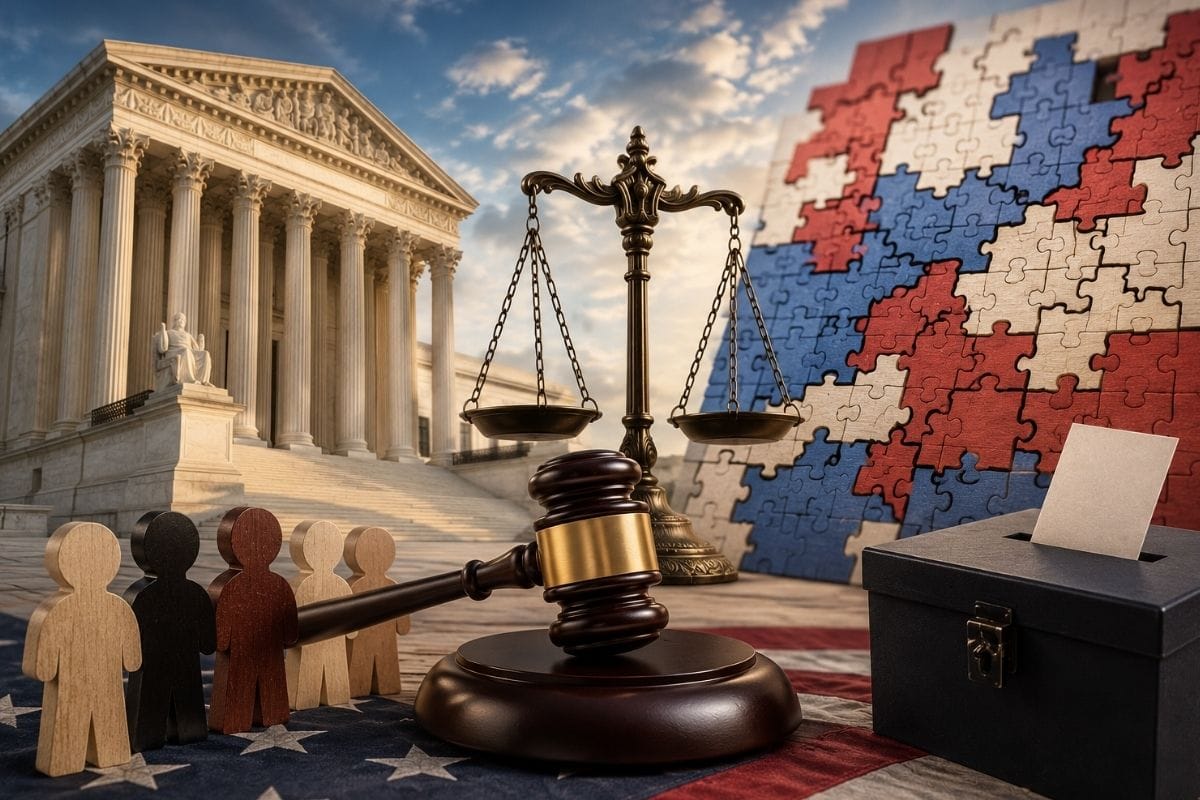
Quick Answer: On April 29, 2026, the Supreme Court threw out Louisiana’s congressional map in a 6-3 vote. The justices called the state’s second Black-majority district an unconstitutional racial gerrymander. In simple terms, it gets more difficult for states to use race when drawing voting lines.
The whole fight over supreme court race based districts came down to one Louisiana map and one question: When can a state use race to protect minority voters? The conservative majority’s answer was blunt: almost never. They didn’t kill the Voting Rights Act but left it on fumes.
- The vote was 6-3, with the conservative justices in charge.
- Justice Samuel Alito wrote the majority opinion. Justice Elena Kagan wrote the dissent.
- Louisiana’s second Black-majority district got tossed as an illegal racial gerrymander.
- Section 2 of the Voting Rights Act survived, but barely.
- To win future cases, people must prove that lawmakers intended to discriminate on the basis of race.
- Republican-led states may now redraw maps before the 2026 midterms.
What the Supreme Court Has Decided
The case is Louisiana v. Callais. Voters who call themselves “non-African American” said the map shuffled people around by skin color, breaking the Constitution. Six justices agreed. Alito wrote that the Constitution “almost never” lets the government sort people by race.
The old way courts read Section 2, he said, sometimes forced states “to engage in the very race-based discrimination that the Constitution forbids.”
The challengers wanted more. They pushed the court to scrap Section 2 entirely. The majority didn’t go that far. But as the BBC laid it out, the ruling still makes it far tougher to challenge a map for weakening minority voting power. You now have to prove legislators drew the lines on purpose to shortchange minority voters.
How We Got Here
Rewind to the 2020 census. Louisiana’s 2022 map had just one majority-Black district out of six in a state where Black residents are about a third of the population. Black voters sued, saying it watered down their voice under Section 2.
A federal judge agreed the map likely broke the law. The 5th Circuit backed that up and told Louisiana to fix it by January 2024. So the state drew a new map with a second Black-majority district. It sent Cleo Fields to Congress in November 2024, a guy who’d served one in the 1990s.
Then came the twist. “Non-African American” voters sued over the new map, saying it leaned too hard on race. A three-judge court agreed, but the Supreme Court paused that ruling in May 2024, then took the case itself.
SCOTUSblog walked through the timeline: the justices first heard arguments in March 2025. Instead of ruling, they did something unusual and set a second round for the fall, asking everyone to focus on whether the district broke the 14th or 15th Amendment.
Also Read – California Governor Race is a Nail-Biter As Count Drags On
The Odd Part About Who Defended the Map
Louisiana defended its map at first, with a clever argument. Once courts forced its hand, it wasn’t thinking about race, just protecting powerful Republicans like House Speaker Mike Johnson and Rep. Julia Letlow. The “non-African American” voters called that “utterly implausible.”
By the second argument in October 2025, Louisiana had flipped sides, leaving only the Black voters defending the map. The Trump administration also got involved. It didn’t ask the court to erase Section 2 but wanted the lower court’s ruling upheld.
The Gingles Test and the New Rulebook
Courts have long used the Gingles test, from the 1986 case Thornburg v. Gingles, to judge these claims. In his 36-page opinion, Alito said he wasn’t scrapping it, just updating it after 40 years.
Here’s what changed. Challenge a map now and you must hand over an alternative that hits all the state’s goals and still adds a minority district. You also have to show racial bloc voting isn’t just people voting by party. Alito leaned on the 2019 Rucho v.
Common Cause decision, which greenlit partisan gerrymandering, and the 2013 Shelby County v. Holder ruling, quoting it to say “things have changed dramatically” in the South since 1965.
Bottom line: Alito said Louisiana’s goal “was racial,” and nothing justified it. The map, he wrote, is “an unconstitutional gerrymander.”
Also Read – The Facts Behind Theodore Barrett’s Viral White House Video
The Concurrence and a Furious Dissent
Justice Clarence Thomas, a longtime critic of the law, went further. Joined by Justice Neil Gorsuch, he said Section 2 “does not regulate districting at all” and called it a “disastrous misadventure”.
Kagan wasn’t having it. Joined by Sotomayor and Ketanji Brown Jackson, she read her 48-page dissent aloud from the bench. The ruling “renders Section 2 all but a dead letter,” she said, warning a state can now “systematically dilute minority citizens’ voting power.”
She called the law “born of the literal blood of Union soldiers and civil rights marchers,” then dropped the usual polite sign-off and closed with just, “I dissent”.
The Reaction was Loud on Both Sides
The rundown from NBC News caught the split. Trump cheered on Truth Social, calling it “a BIG WIN for Equal Protection under the Law.” The White House called it a “complete and total victory,” and Louisiana Attorney General Liz Murrill called it “seismic”.
Civil rights folks were crushed. NAACP President Derrick Johnson said, “The Supreme Court betrayed Black voters”. Senate Democrat Chuck Schumer called it a “devastating blow,” and election law expert Justin Levitt described it as burning the house down.
Also Read – HMRC Admitted Overclassifying and Overtaxing Millions of State Pensioners Since 2010
What Happens Next
Coverage from Le Monde zoomed out. Democracy Docket figured the ruling could hand Republicans 27 extra House seats “for at least a generation.” Florida’s already redrawing to grab seats, with Tennessee and Mississippi maybe next.
The court had chipped away at the law before, in 2013 and 2021, though it surprised everyone by protecting it in a 2023 Alabama case.
The clock’s ticking. Louisiana’s primary is May 16, so the challengers asked the court to speed up its final order and skip the usual 32-day wait.
FAQs
- What is the Supreme Court race-based districts case?
Ans: It’s Louisiana v. Callais, decided April 29, 2026. The court ruled 6-3 that Louisiana’s second Black-majority district was an unconstitutional racial gerrymander.
- Did the court end the Voting Rights Act?
Ans: No, Section 2 is still on the books. But the ruling makes it nearly useless, since you must prove lawmakers discriminated by race on purpose.
- Who wrote the majority opinion?
Ans: Justice Samuel Alito. He was joined by Roberts, Thomas, Gorsuch, Kavanaugh, and Barrett, the court’s conservative wing.
- Who dissented?
Ans: Justices Kagan, Sotomayor, and Jackson. Kagan warned the fallout would be “far-reaching and grave”.
- How does this ruling hit the 2026 elections?
Ans: Florida, Tennessee, and Mississippi may redraw maps. Analysts say the change could help Republicans win more House seats. - Why did Louisiana switch sides?
Ans: After courts forced it to add a second Black-majority district, the state decided the map was unconstitutional and joined the voters fighting it.
Sources & References:
- BBC – The ruling still makes it hard to challenge a map for weakening minority voting power.
- SCOTUS Blog – The justices first heard arguments in March 2025.
- NBC News – Trump, the White House, and Louisiana Attorney General Liz Murrill were split on this ruling.
- Le Monde – Democracy Docket figured the ruling could hand Republicans 27 extra House seats “for at least a generation”.