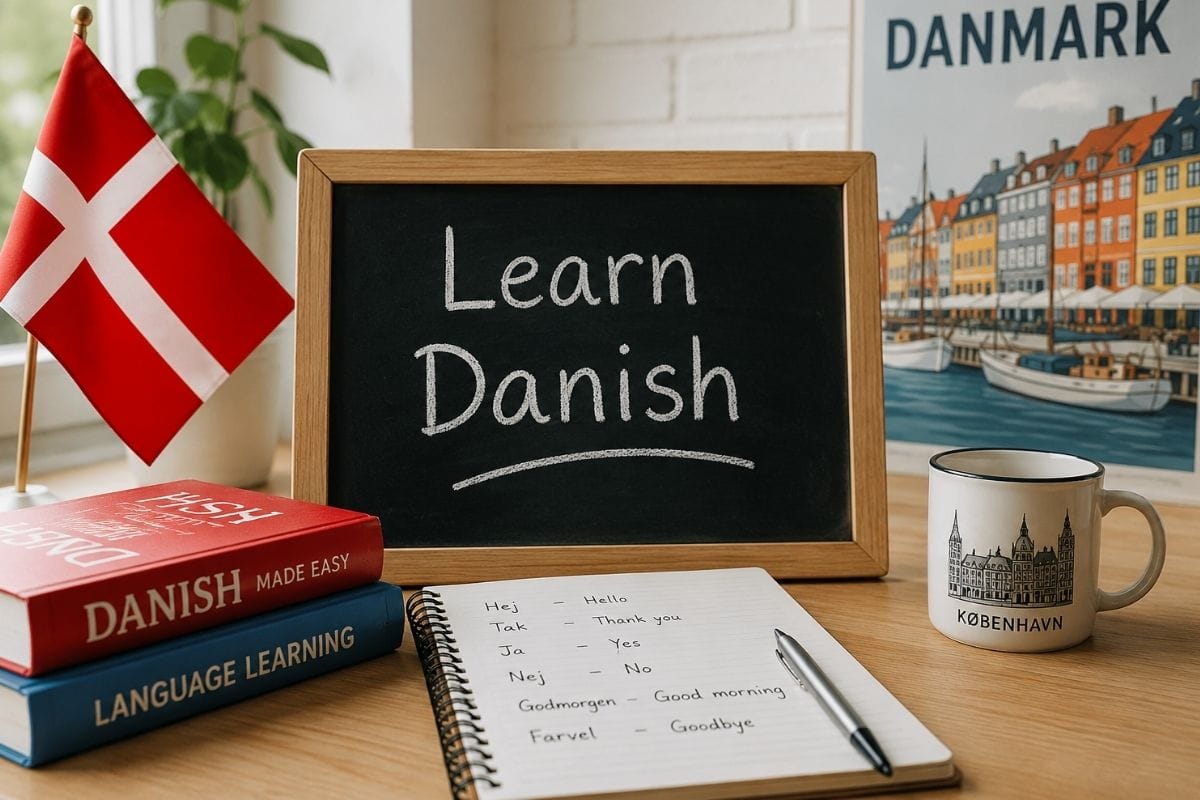
The US State Department has been putting diplomats through intensive language training since 1947 and recording how long each one takes. That dataset is the closest thing anyone has to a controlled measurement of language difficulty, and it produces an answer most lists do not: the shortest course on the schedule is Danish, at 552 classroom hours.
Whether Danish is the right choice for you is a different question, and the hours alone will mislead you if you stop there.
The Short Summary
The Foreign Service Institute groups languages by the classroom hours a native English speaker needs to reach professional working proficiency. The easiest tier, Category I, runs roughly 600 to 750 hours, or 24 to 30 weeks of full-time study.
Danish sits at the bottom of that range at around 552 hours. Italian, Portuguese, French, Romanian and Dutch cluster near 24 weeks. Spanish takes around 690 hours, six weeks longer than Italian, despite its reputation as the classic starter language.
Category I: The Easiest Group
These languages are closely related to English, mostly Germanic and Romance:
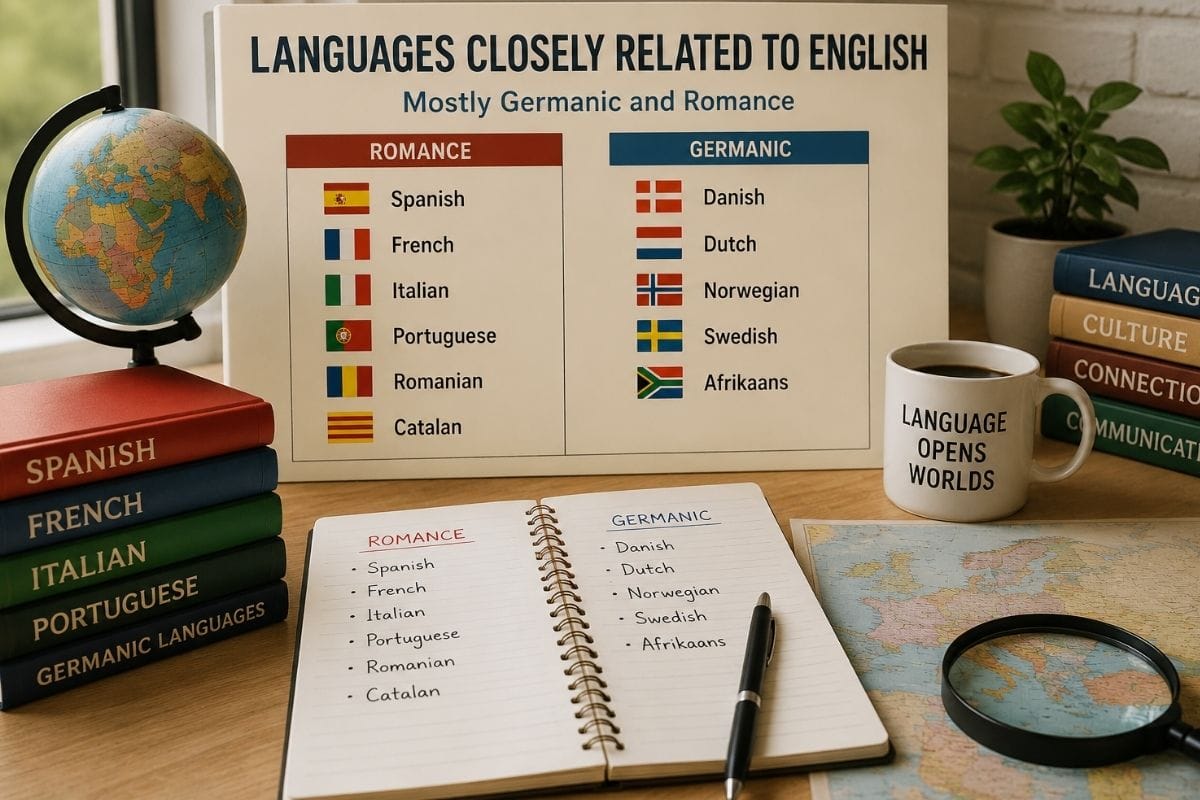
- Romance: Spanish, French, Italian, Portuguese, Romanian, Catalan
- Germanic: Danish, Dutch, Norwegian, Swedish, Afrikaans
They share the Latin alphabet, a large stock of cognate vocabulary, broadly familiar sentence structure and no tones.
Afrikaans deserves a mention it rarely gets. It has no verb conjugation by person, no grammatical gender and a radically simplified tense system compared with Dutch, from which it descends. On pure grammatical load it is arguably the lightest language on the list.
What Comes Next
| Category | Hours | Languages |
| I | ~600-750 | Spanish, French, Italian, Portuguese, Dutch, Danish, Norwegian, Swedish, Afrikaans, Romanian |
| II | ~900 | German, Indonesian, Swahili, Haitian Creole |
| III | ~1,100 | Russian, Hindi, Greek, Hebrew, Polish, Turkish, Thai, Vietnamese, Finnish, Hungarian |
| IV | ~2,200 | Arabic, Mandarin, Cantonese, Japanese, Korean |
Indonesian is the outlier worth knowing about. It sits in Category II because of cultural and structural distance from English, but it has no verb conjugation, no grammatical gender, no tones, no articles and a Latin alphabet. Many learners find it easier in practice than its category suggests. It is the strongest case that the FSI numbers measure distance from English rather than complexity in the abstract.
German takes longer than French despite being closer to English on the family tree. Four cases, three genders and separable verbs account for most of the gap.
Three Things The Hours Do Not Tell You
They are classroom hours only. FSI students do roughly the same amount again in homework. The realistic total for Category I is well over a thousand hours of contact with the language.
The conditions are unrepeatable. FSI training is full-time, small-group, with native-speaker instructors and highly motivated adults. An hour a week on an app is a different activity, and the FSI figure does not scale down to it cleanly.
The target is not fluency. The measure is Speaking-3 and Reading-3 on the Interagency Language Roundtable scale, meaning professional working proficiency, roughly upper B2 to low C1. Conversational competence arrives considerably earlier. Native-like command takes far longer.
What Makes a Language Easy For You
The FSI table assumes a monolingual English speaker with no prior exposure. Change those assumptions and the ranking changes.
Your existing languages. Your existing languages. A Spanish speaker learning Portuguese or Italian is doing something closer to dialect acquisition than language learning. Country facts such as where a language is spoken, how many countries use it and how widely it is taught can also affect its practical value. This is also why comparing these rankings with the hardest language to learn can be useful: difficulty is highly dependent on what you already know.
Writing system. A new script adds hundreds of hours before you can read anything. It is also front-loaded, meaning it feels brutal early and stops mattering.
Available material. Spanish has more graded readers, podcasts, dubbed television and conversation partners than Danish by an enormous margin. Volume of comprehensible input drives progress more than grammatical simplicity does.
Reason to use it. Access to speakers, a trip booked, a job, family. Motivation compounds and everything else is secondary to it.
The honest answer to the question follows from that: the easiest language to learn is the one you have a reason to speak and enough material to practise with. Danish wins on the stopwatch and loses badly on both of those.
Frequently Asked Questions
What is the easiest language to learn for English speakers?
The Foreign Service Institute’s Category I languages, at roughly 600 to 750 classroom hours. Danish has the shortest listed course at around 552 hours.
How long does it take to learn Spanish?
Around 690 classroom hours by FSI measurement, roughly 30 weeks of full-time study, plus a similar amount of homework.
Is Spanish or French easier?
FSI places both in Category I. French has more irregular spelling and pronunciation; Spanish has more consistent spelling and more available learning material.
Is Afrikaans easy to learn?
It has no verb conjugation by person, no grammatical gender and a simplified tense system, which makes it one of the lightest Category I languages grammatically.
Why is German harder than French?
Four grammatical cases, three genders and separable verbs, which together place it a category above the Romance languages despite being closer to English by descent.
Do the FSI hours apply to app learning?
No. They describe full-time intensive classroom instruction with native-speaker teachers. Casual study takes considerably longer in calendar time.
The Bottom Line
Category I is where to look, and Danish, Italian and Portuguese sit at the shortest end of it. Then ignore the table and pick from that group on the basis of who you will speak it with and what you will read, watch and listen to. The 138-hour gap between Danish and Spanish disappears the moment you factor in how much more Spanish there is to consume.
You can also compare these figures with The most spoken language in the world to see why the easiest language on paper isn’t necessarily the most practical one to learn.
Sources
US Department of State, Foreign Service Institute language difficulty rankings; Interagency Language Roundtable proficiency scale; Ethnologue.
Reviewed against Foreign Service Institute published category data. FSI hour figures describe full-time classroom instruction and are not directly comparable to self-study. Last reviewed 12 August 2026.