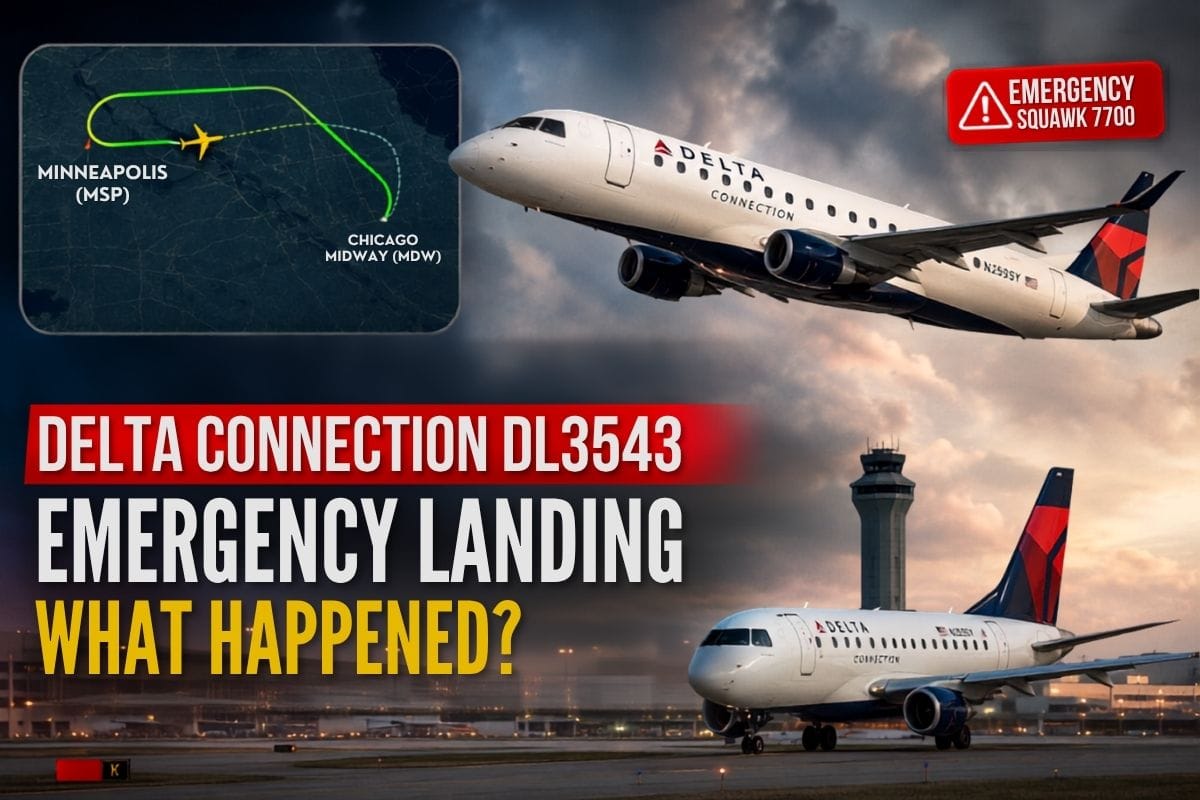
Quick answer: Delta Connection flight DL3543 turned back to Minneapolis on July 7, 2025, after it stopped climbing at around 21,000 feet. The crew declared an emergency and landed safely. The cause hasn’t been confirmed.
A Delta Connection flight from Minneapolis–Saint Paul International Airport (MSP) to Chicago Midway International Airport (MDW) turned back shortly after takeoff, and the incident has been getting attention online since.
The aircraft stopped climbing at roughly 21,000 feet, then turned back toward Minneapolis about 10 minutes after departure, according to recent aviation reports. The crew declared an emergency and squawked 7700, the code that flags an emergency to air traffic control. The plane landed safely back at Minneapolis about 37 minutes after it took off.
Plenty of explanations are floating around online, but the underlying report doesn’t name a technical cause. Claims about mechanical, electrical, or pressurization failures should be treated as unconfirmed until an airline statement or investigation says otherwise.
- Flight: Delta Connection DL3543
- Date: July 7, 2025
- Route: Minneapolis–Saint Paul (MSP) to Chicago Midway (MDW)
- Aircraft: Embraer regional jet, registration N259SY
- Outcome: Returned to Minneapolis and landed safely after declaring an emergency
What Happened on Delta Connection Flight DL3543?
DL3543 left Minneapolis–Saint Paul International heading for Chicago Midway on what should have been a short hop.
The takeoff was normal. During the climb, though, the aircraft leveled off at about 21,000 feet instead of continuing up. About 10 minutes in, the crew turned around and headed back to Minneapolis.
They squawked 7700, the standard emergency transponder code, which tells air traffic control the aircraft needs help. The FAA lists 7700 as the code for exactly this situation.
Rather than push on toward Chicago, the crew brought the aircraft back to the airport it had just left, putting it within reach of emergency crews and maintenance staff who already knew the flight.
AIRLIVE reported that DL3543 landed on Runway 12R in Minneapolis about 37 minutes after takeoff and taxied to stand C12.
Delta Connection DL3543 Flight Details
| Detail | Information |
|---|---|
| Flight number | DL3543 |
| Airline brand | Delta Connection |
| Departure | Minneapolis–Saint Paul International Airport (MSP) |
| Planned destination | Chicago Midway International Airport (MDW) |
| Date | July 7, 2025 |
| Aircraft | Embraer regional jet |
| Registration | N259SY |
| Emergency code | Squawk 7700 |
| Action taken | Returned to Minneapolis |
| Landing | Runway 12R |
| Reported outcome | Safe landing |
Delta’s regional network, branded Delta Connection, is flown by carriers like Endeavor Air, Republic Airways, and SkyWest Airlines, all operating under Delta’s flight numbers.
Why Did DL3543 Make an Emergency Return?
Here’s where it matters to separate what’s confirmed from what’s guesswork.
What’s documented is that the aircraft stopped climbing, turned back, and declared an emergency. What isn’t documented is why. No technical explanation appears in the available reporting.
Various sites have floated pressurization problems or other technical issues, but the accounts don’t line up with each other; some can’t even agree on the operating carrier or the direction of the flight, which makes them hard to trust.
Given that, there’s no way to say with confidence which system failed, or whether a specific cockpit warning triggered the decision to turn back.
Whatever it was, it was serious enough for the crew to abandon the flight and ask for priority handling on the way in.
That’s worth sitting with for a second: declaring an emergency doesn’t automatically mean the plane was in danger of going down.
What Does Squawk 7700 Mean?
Seeing “7700” pop up on a flight tracker can look alarming if you don’t know what it means. In aviation terms, it’s fairly specific and fairly routine.

The FAA’s Aeronautical Information Manual instructs pilots in distress or facing an urgent situation to select Mode 3/A Code 7700, the emergency code, so ground radar can identify them.
FAA air traffic control procedures back this up: 7700 flags the aircraft on controllers’ screens once an emergency has been declared, so they know to treat it differently from other traffic.
In practice, squawking 7700 tells controllers a few things at once:
- The aircraft needs help.
- It may need priority handling over other traffic.
- Other aircraft nearby may need to be rerouted.
- Airport emergency services may need to be on standby.
- The situation needs immediate attention.
So spotting 7700 on a tracker tells you something is wrong. It doesn’t tell you what.
Why Did the Pilots Turn Back to Minneapolis?
Turning back to the departure airport is often the more sensible move when something goes wrong soon after takeoff, and DL3543 was still close enough to Minneapolis that flying on toward Chicago, roughly an hour away, wasn’t the obvious choice.
A few things make that decision practical:
A familiar airport. The crew had just left Minneapolis, so the airport was already part of their operating picture.
Emergency support on the ground. Airport crews had time to prepare for the arrival.
Maintenance on hand. Once down, the aircraft could be checked by qualified staff right away.
Less time in the air. Turning back sooner means less time flying with an unresolved issue.
FAA emergency procedures call for pilots in this kind of situation to stay in contact with air traffic control and communicate what’s going on, what they intend to do, and what they need.
How the DL3543 Emergency Landing Unfolded
Based on what’s publicly known, here’s the sequence:
- Departure from Minneapolis. DL3543 left Minneapolis–Saint Paul International on July 7, 2025, headed for Chicago Midway.
- Climb. The Embraer climbed to roughly 21,000 feet.
- Climb stops. Instead of continuing toward cruise altitude, the aircraft leveled off.
- Turnaround. About 10 minutes after takeoff, the crew turned back toward Minneapolis.
- Emergency declared. The crew squawked 7700, alerting air traffic control.
- Return to MSP. The aircraft headed back rather than continuing to Chicago.
- Safe landing. DL3543 touched down on Runway 12R roughly 37 minutes after departure and taxied to stand C12.
None of that reads as chaotic. It reads like a crew working through a checklist.
Was the Delta Connection DL3543 Emergency Landing Dangerous?
The word “emergency” tends to sound worse than the situation usually is.
Pilots train to treat abnormal readings or alerts conservatively. If something creates doubt mid-flight, turning back is often the more cautious call, not a sign that things were already going badly.
That’s not to say there was zero risk. It’s just that declaring an emergency is itself a form of managing risk, not evidence that the risk had already gotten out of hand.
Squawking 7700 lets controllers and ground crews get ready before the plane even lands, which is exactly the point of the code.
What Happened to the Passengers?
Public reporting confirms the aircraft made it back safely. It doesn’t include a passenger count or firsthand accounts from anyone on board.
If you’re on a flight that turns back and hears the crew has declared an emergency, it’s unsettling, understandably so.
The best thing to do in that moment is to follow the cabin crew’s instructions: stay seated when told to, keep your seatbelt on unless instructed otherwise.
After landing, the airline typically checks whether the aircraft needs maintenance, whether passengers need a different plane, and how to get everyone moving again.
What Happens After an Emergency Landing?
Landing doesn’t necessarily end the process. Depending on what happened, a few things usually follow:
Aircraft inspection. Maintenance staff look into whatever the crew reported.
Operational review. The airline goes back over flight data, crew reports, and maintenance history.
Passenger rebooking. If the original aircraft can’t fly again right away, passengers get moved to another flight.
Further investigation. Depending on severity, aviation authorities may get involved.
How far this goes depends on what actually happened, which, in this case, still isn’t public.
Was DL3543 Operated by Delta Air Lines?
Delta Connection isn’t Delta’s own fleet; it’s a brand under which regional partners fly.
Endeavor Air, Republic Airways, and SkyWest Airlines all operate flights under Delta’s network using Delta flight numbers.
That distinction matters when you’re trying to pin down who was actually flying the plane.
For DL3543, the registration N259SY is confirmed. Beyond that, there isn’t enough in the available reporting to verify every claim circulating online about which carrier operated it.
What We Know and What We Don’t
Keeping confirmed facts separate from later speculation matters here.
Confirmed by available reporting:
- The incident happened on July 7, 2025.
- DL3543 was flying from Minneapolis to Chicago Midway.
- The aircraft was registered N259SY.
- It stopped climbing at about 21,000 feet.
- It turned back roughly 10 minutes after departure.
- The crew squawked 7700.
- It landed safely at Minneapolis about 37 minutes after departure.
- It taxied to stand C12.
Not established by the evidence available:
- The precise technical fault.
- Whether a pressurization system failed.
- Whether an electrical issue was involved.
- The specific cockpit warning that prompted the turnaround.
- Detailed accounts from passengers.
Why Emergency Returns Are Part of Aviation Safety
If anything, an event like this shows the safety system doing what it’s supposed to do.
Pilots are trained to catch abnormal situations early. Aircraft carry redundant systems and procedures built for exactly this kind of problem. Controllers and airport crews are there to help once a plane turns back.
Choosing to return instead of pushing on is a judgment call, and a conservative one. It isn’t proof the flight was close to disaster.
With DL3543, the known facts are simple: it stopped climbing, turned back, declared an emergency, and landed without incident.
Conclusion
DL3543 turned back to Minneapolis on July 7, 2025, shortly after leaving for Chicago Midway. The climb stopped at around 21,000 feet, the crew turned around about 10 minutes in, squawked 7700, and landed on Runway 12R roughly 37 minutes after takeoff.
A lot of sites have guessed at what caused it. None of that guessing is confirmed. Claims about a specific mechanical, electrical, or pressurization failure need better sourcing before anyone should treat them as fact.
What’s clear is that the crew noticed something off, talked to air traffic control, turned back, and landed safely. That’s the system working as intended.
FAQs
What happened to Delta Connection DL3543?
It was flying from Minneapolis to Chicago Midway on July 7, 2025, when it stopped climbing and turned back. The crew declared an emergency using code 7700, and it landed safely at MSP.
Why did DL3543 return to Minneapolis?
That part isn’t clear from the public reporting. What’s confirmed is that the aircraft stopped climbing, turned around, and declared an emergency.
What does 7700 mean on a flight tracker?
It’s the standard emergency transponder code. Pilots use it to alert ground radar to an emergency.
Did DL3543 crash?
No. It returned to Minneapolis and landed safely about 37 minutes after departure.
Did Delta Connection DL3543 reach Chicago?
No, it turned back before getting there.
What aircraft was used for DL3543?
An Embraer regional jet, registered N259SY.
Is an emergency landing always dangerous?
No. Declaring an emergency just means the crew needed urgent help or was dealing with something unusual, not that the flight was in danger of crashing.
Where did DL3543 land?
Back at Minneapolis–Saint Paul International Airport, on Runway 12R.
Is the cause of the DL3543 emergency landing confirmed?
No, not based on what’s publicly available right now.
What should passengers do during an in-flight emergency?
Stay calm, follow the flight attendants instructions, keep your seatbelt fastened when told to, and listen to the safety announcements. The crew is trained for this.
Sources & References
- Federal Aviation Administration (FAA) — Emergency Procedures — Guidance on emergency transponder operations and squawk 7700.
- FAA — Air Traffic Control: Emergency Code Assignment — Official information on Code 7700 and emergency aircraft handling.
- FAA — Distress and Urgency Procedures — Pilot procedures for declaring and managing an aviation emergency.
- AIRLIVE — Delta Connection Flight DL3543 Is Declaring an Emergency and Returning to Minneapolis — Contemporary reporting on the DL3543 incident, including the flight’s return and landing details.