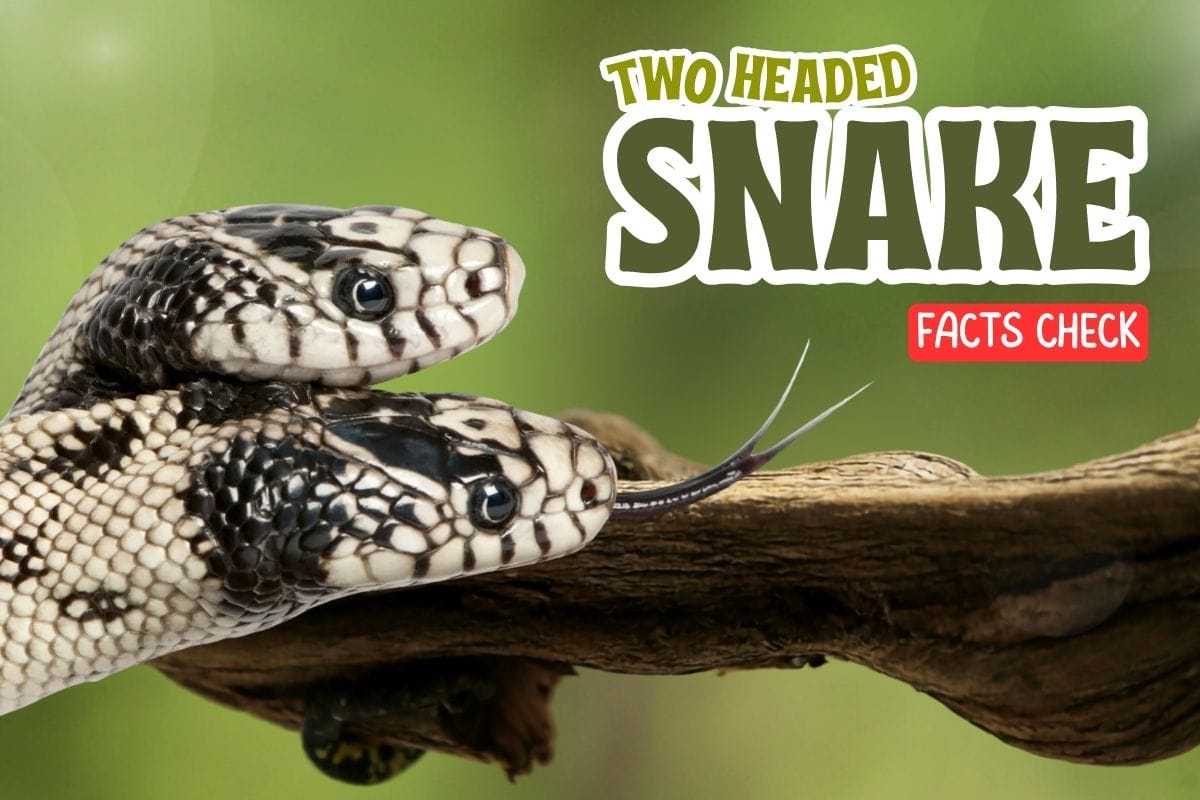
Quick Answer: About 1 in 100,000 snakes is born with two heads, which is close to a 0.001% chance. It’s called bicephaly, and it happens when an embryo splits into twins and stops halfway. Most don’t last long in the wild, though a few captive ones have a lifespan of 17 to 20 years.
In an age of deepfakes, you’d be forgiven for seeing a photo of a two-headed snake and assuming Photoshop. But no, they’re real, and we’ve been seeing them for ages.
- Bicephaly is a form of polycephaly, which means more than one head.
- Each head normally has its brain, eyes, tongue, and teeth.
- Reptiles show this trait more often than mammals.
- What is doubled inside varies from snake to snake.
- Long lives happen in captivity, not in the grass.
What is a Two-Headed Snake?
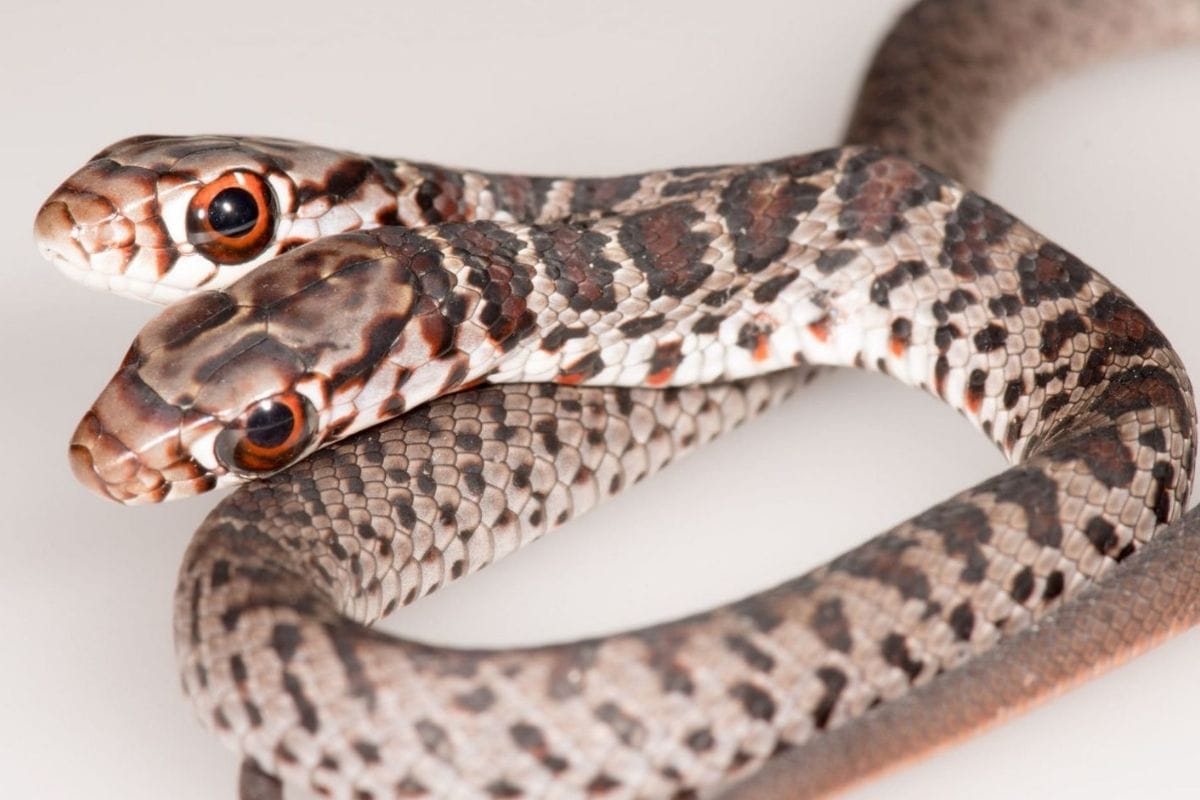
“Bi” means two, and “cephaly” means head. The general term is polycephaly: any animal with more than one head.
Each head usually has its brain, eyes, tongue, and teeth. So it isn’t one weird snake. It’s two snakes stuck in one skin, mostly unaware that the other exists.
It happens to other animals too: bulls, sharks, turtles, prawns, cows, porpoises, and cats. ABC News points out that this anomaly has been showing up for at least 150 million years.
The Biology Behind Two Heads
Two heads come from an embryo that starts splitting into identical twins and then stops. Scientists call it axial bifurcation. It’s the same phenomenon that produces conjoined twins in people.
Justin Adams of Monash University, who studies anatomy across the animal kingdom, adds a second route: two separate embryos can partly fuse and end up joined.
Where the split stalls decides everything. Like conjoined twins joining at the head, chest, or hip, snakes can be joined anywhere along the body. Causes can be genetic or environmental, but the trait almost never gets passed down because these animals rarely live long enough to breed.
Also Read – Before You Laugh at a Fat Monkey, Here’s What to Know
Why Reptiles Beat Mammals at This
Adams gives two reasons. First, reptiles produce loads of offspring. Second, reptile eggs sit outside the mother, exposed to temperature swings, radiation, and chemical toxicity.
Mammal moms filter these out. “If there are errors in development, there are miscarriages and spontaneous abortions,” he said. Animals with irregularities like these probably conceive far more often than we notice. Most never make it to birth.
Inbreeding in captivity increases the odds, and keepers keep the hatchlings alive.
How Rare is a Two-Headed Snake?
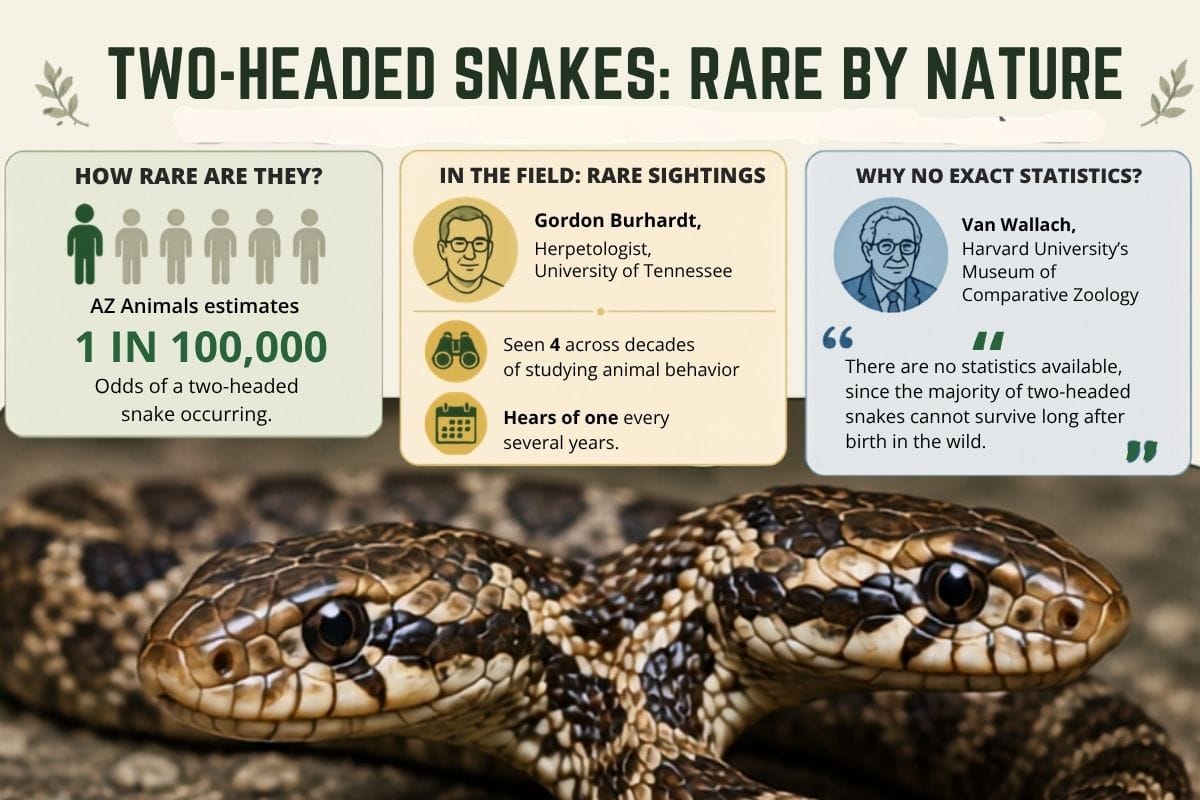
AZ Animals puts the estimate at one in 100,000. Gordon Burghardt, a herpetologist at the University of Tennessee, has seen four across decades of studying animal behavior and hears of one every several years.
Van Wallach of Harvard University’s Museum of Comparative Zoology said: “There are no statistics available, since the majority of two-headed snakes cannot survive long after birth in the wild.” He suspects captivity produces more, but nobody can test that.
What is Actually Duplicated Inside
As Burghardt said, “It’s not an evolved trait, so each two-headed animal would be highly individual.”
| Case | Anatomy | How it went |
| Black rat snake, Burghardt’s lab | Two throats, two stomachs | About 20 years |
| King snake, Arizona State | Separate necks, one shared stomach | Nearly 17 years |
| Copperhead, Woodbridge, Virginia | Single stomach | Found in a flower bed |
| Yellow anaconda, Brazil | Two hearts, three lungs, two livers, two stomachs | The full works |
| Boa constrictor, Florida | Two hearts, likely two gut tracts | Two weeks old |
| Ladder snake, Pinoso, Spain | Heads joined at neck level | Eight inches at two months |
Burghardt also found that if their heads are close to each other, they struggle, while a separation lets each side act on its own.
Vets Susan Kelleher and Lauren Thielen x-rayed that Florida boa and found something almost unheard of. “I was shocked it has two hearts,” Thielen said, confirming both with a Doppler ultrasound. Boas are born live, so that split happened in the womb.
Also Read – What Dog Has the Strongest Bite Force?
Life With Two Heads is Hard
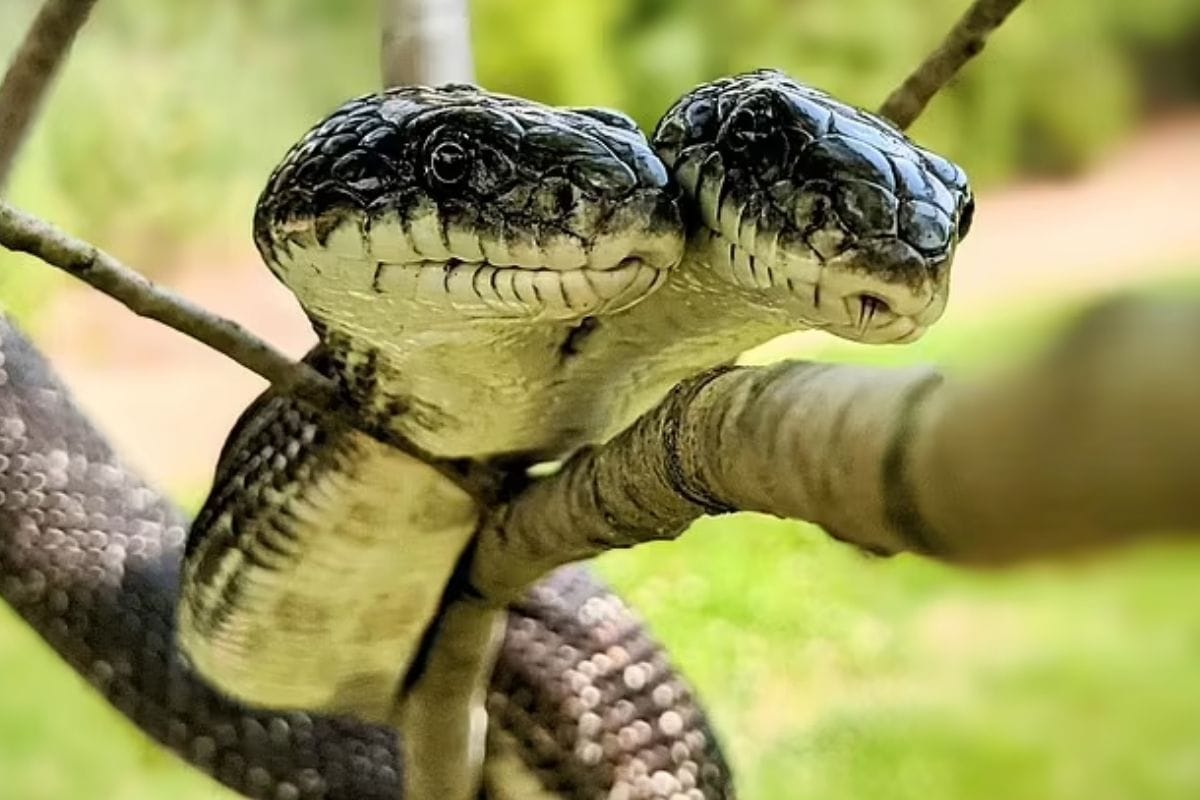
A biology write-up on Steemit states that both brains send orders to the same muscles at once. Hunting turns into a mess.
- They fight over prey, and feeding takes forever while the snake sits exposed.
- One head smells food on the other and tries to swallow it.
- Two brains, two directions, and the pushier head drags the other along.
- Share a stomach, and one head eats while the other still feels starved.
- Under attack, both react differently and lose the seconds that matter.
Keepers use a divider between the heads at feeding time.
Famous Cases Worth Knowing
Thelma and Louise, a two-headed corn snake at the San Diego Zoo, had 15 normal babies. Medusa, an albino Honduran milk snake bought by Todd Ray, ate her first mouse on camera without drama.
National Geographic covered the young ladder snake found near Pinoso in Spain, a non-venomous species headed for a research lab. Wikipedia’s polycephaly list includes a live two-headed snake seen in Paris in 1853 and preserved specimens at the Georgia State Capitol in Atlanta.
Two Heads Beyond Snakes
Janus cats, named after the two-faced Roman god, have a related condition called diprosopus, which some scientists tie to extra activity in the sonic hedgehog gene. A two-headed bull shark turned up off the Florida Keys, and two-headed fish larvae in Australia’s Noosa River sparked a pesticide fight that officials later dismissed.
In humans, conjoined twins show up in roughly 1 in 50,000 to 100,000 pregnancies, but only about 1 in 200,000 live births.
Also Read – Is Tonic Water Good for Health?
Why Scientists Study Them
John Kleopfer, the Virginia herpetologist who bagged the copperhead, was “dumbfounded” to find one outside captivity. Enrique Font at the University of Valencia wants to know how two heads handle courtship. James Badman of Arizona State calls two heads a hindrance in the wild.
Burghardt sums it up: “These animals shouldn’t be looked at as freaks. They’re organisms with motivations and individuality just like any other.”
FAQs
- How rare is a two-headed snake?
Ans: Around 1 in 100,000 births, about 0.001%. No verified count exists, since most die before anyone spots them.
- Do two-headed snakes have two brains?
Ans: Yes. Each head gets its brain, eyes, tongue, and teeth, so both sides think and react separately.
- How long do two-headed snakes live?
Ans: Usually a few months in the wild. With good captive care, some reach 17 to 20 years.
- Can two-headed snakes reproduce?
Ans: They can, though it’s rare. Thelma and Louise produced 15 babies, all born normally.
- Why do the two heads attack each other?
Ans: Snakes track prey by smell. If one head smells food on the other, it may strike and try to eat it.
- Are two-headed snakes venomous?
Ans: Depends on the species. The Virginia copperhead is venomous, while ladder and corn snakes aren’t.
Sources & References:
- ABC News – This anomaly has been showing up for at least 150 million years.
- National Geographic – A young ladder snake found near Pinoso in Spain, a non-venomous species, was sent to a research lab.
- AZ Animals – One in 100,000 snakes is two-headed.
- Steemit – Both brains of a two-headed snake send orders to the same muscles at once.