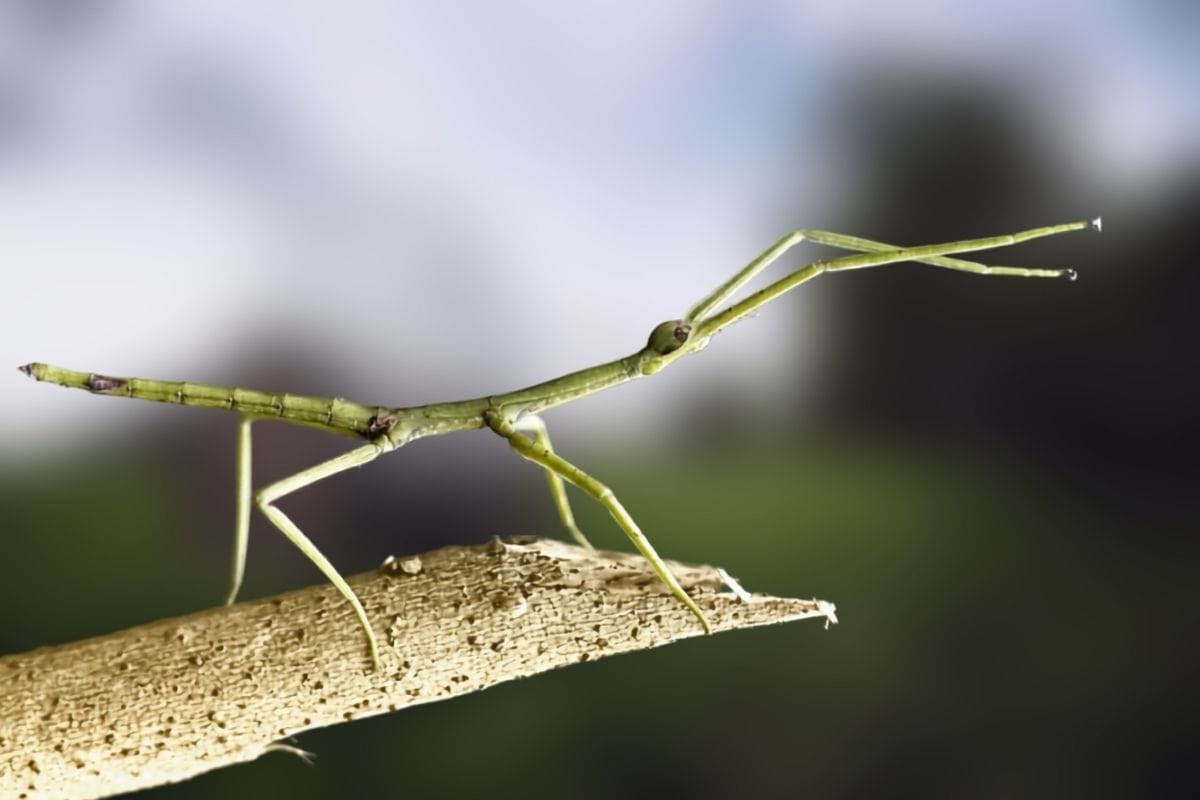
Quick Answer: Stick insects are the ultimate con artists of the bug world. They look so much like twigs and leaves that predators walk right past them. And the disguise is just the opening act. These bugs regrow lost legs, flop over and “die” on command, spray stinging chemicals, and pump out babies without ever meeting a male.
You could hold a stick insect in your hand and still think you’re holding a twig. Scientists call them Phasmatodea. The name comes from a Greek word for “phantom”. You’re basically looking at a plant that turned out to be alive. There are over 3,000 species of these insects.
- They pretend to be sticks and leaves to dodge predators.
- They live on every continent except Antarctica.
- Females can make babies without males.
- Some regrow legs, flip colors, or play dead.
- Bats are their nightmare because they hunt by sound.
Physical Appearance Looks Like a Twig
Camouflage is their identity. Most of them are brown, green, or black, with long skinny bodies that basically dissolve into a branch. Some of them sway side to side while walking, faking a twig blowing in the wind. The National Wildlife Federation says that these motions actually help sell the act to whatever’s watching.
A few stick insects grow lichen-like fuzz on their bodies to match rough tree bark. Then there’s Carausius morosus, which changes color to match wherever it’s sitting. A bug that changes its color with the background.
Size Records That’ll Make Your Jaw Drop
Depending on the species, they grow from 1 to 12 inches (2.5 to 30 centimeters) long, and the females usually tower over the males.
Stick insects are the biggest insects in the world. The biggest is Phryganistria chinensis from China, which is 64 centimeters (25 inches) with its legs out. Before it stole the crown, the Chan’s Megastick (Phobaeticus chani) from Borneo held the record after its discovery in 2008, at 22 inches with legs extended and a 14-inch body.
The heaviest one is Heteropteryx dilatata, whose females can be 65 grams (2.3 ounces). And the smallest one is Timema cristinae, under an inch long.
Also Read – How Rare is a Two-Headed Snake?
Where do stick insects live?

Walking sticks are found on every continent except Antarctica. They mostly live in temperate and tropical regions. Blue Planet Aquarium mentions they’re partial to steamy, humid forests.
You’d bet they hide in stick piles on the ground, right? Wrong. Most of them just sit out in the open on trees. Over 300 species live on the island of Borneo, the richest spot on Earth for these bugs.
What Stick Insects Eat?
All walking sticks are herbivores. They use their strong mandibles to consume leaves, the primary food in their diet. Basically, they’re eating machines, chomping away almost nonstop because they’re always starving.
And their poop isn’t wasted either. Their droppings break down leftover plant bits that other insects then feast on. So even their waste is useful for forest life.
Their Sneaky Bag of Tricks
When camouflage fails, these bugs have backup plans. The San Diego Zoo describes how some flash bright, colorful wings, then dive to the ground and slam them shut. The predator’s left frantically hunting a flashy bug but only finding a dull heap of sticks.
Others reek on purpose or blast a chemical that stings like tear gas. The Peruvian fire stick leaks a milky irritant, which is why it flaunts loud red, black, and yellow “don’t you dare” colors. Some just faint dramatically. That’s called “thanatosis”, where they drop and go stiff until they are out of danger. And what if a bird eats a leg? They grow a new leg during the next molt.
Also Read – Before You Laugh at a Fat Monkey, Here’s What to Know
Breeding Without Males
ThoughtCo explains that females can reproduce almost without males through parthenogenesis. An unmated female just lays her eggs, and boom, they hatch into more females.
When a male does crash the party, there’s only a coin-flip chance the babies come out male. Some species are such a girls’ club that scientists have never spotted a single male. One captive female can crank out hundreds of all-female kids without ever dating anybody.
Eggs That Look Like Seeds

Even their eggs look like little seeds, so predators barely see them. Some moms give one egg a day while wandering, scattering them so nothing can devour the whole clutch in one bite. Others stash them in soil, in bark, or under leaves.
Loads of eggs come with a fatty knob on the end called a capitulum. Ants drag them home to their nests. Once they’ve slurped up the fat, they chuck the leftover egg onto their trash heap, where it cooks underground until the baby wriggles out. A free babysitting service, courtesy of ants who got played.
Life Cycle and Lifespan
Stick insects grow through incomplete metamorphosis in three stages: egg, nymph, and adult. Right after hatching, a nymph usually gobbles up its shed skin so there’s zero evidence left behind for hungry eyes.
They hit full size after a bunch of molts. Most stick around anywhere from a few months to three years, and it all depends on the species.
Also Read – What Dog Has the Strongest Bite Force?
Facing Bats and Human Threats
Walking sticks are a favorite food of many animals, but perhaps their most effective predators are bats. Bats hunt by echolocation, so the twig cosplay is useless when a bat’s tracking you by sound in the pitch dark.
And then there are humans. Habitat loss, pesticides, and grabbing them for the pet trade put loads of species in danger. The Lord Howe Island stick insect was flat-out declared extinct until it dramatically reappeared on a lonely spike of rock called Ball’s Pyramid.
Stick insects share their order with leaf insects, which are equally well camouflaged. Between those two, nature will help a creature survive.
FAQs
- What are stick insects?
Ans: They’re plant-munching bugs in the order Phasmatodea. They look like twigs or leaves, which helps them vanish among trees and bushes. - Can stick insects have babies without males?
Ans: Yes, females use parthenogenesis to lay eggs that hatch into more females. Some species have never had a male found at all. - What do stick insects eat?
Ans: They’re herbivores that mostly eat fresh leaves. Their strong mandibles let them chew foliage pretty much all day. - How big can stick insects get?
Ans: Most run from 1 to 12 inches. The longest, Phryganistria chinensis, hits around 25 inches with its legs stretched out. - What eats stick insects?
Ans: Bats, mainly. Since they hunt by echolocation, the twig disguise means nothing to them in the dark. - How long do stick insects live?
Ans: Most live from a few months up to three years. It depends on the species and where they call home.
Sources & References:
- NWF – Their side-to-side motions help them fool the watching eyes of the predators.
- ThoughtCo. – Females can reproduce almost without males through parthenogenesis.
- Blue Planet Aquarium – They mostly live in temperate and tropical regions.
- San Diego Zoo – Some flash bright-colored wings, then drop to the ground and hide them, leaving the predator confused.