Around 4,000 cattle a year qualify as Kobe beef. That is the entire global supply, and it is smaller than the number of restaurants worldwide advertising a Kobe burger. The gap between those two figures is the single most useful thing to understand about this subject.
The rest of it comes down to a grading system that most menus quote without explaining, and a letter that carries a different meaning from the one most readers assign to it.
The Short Summary
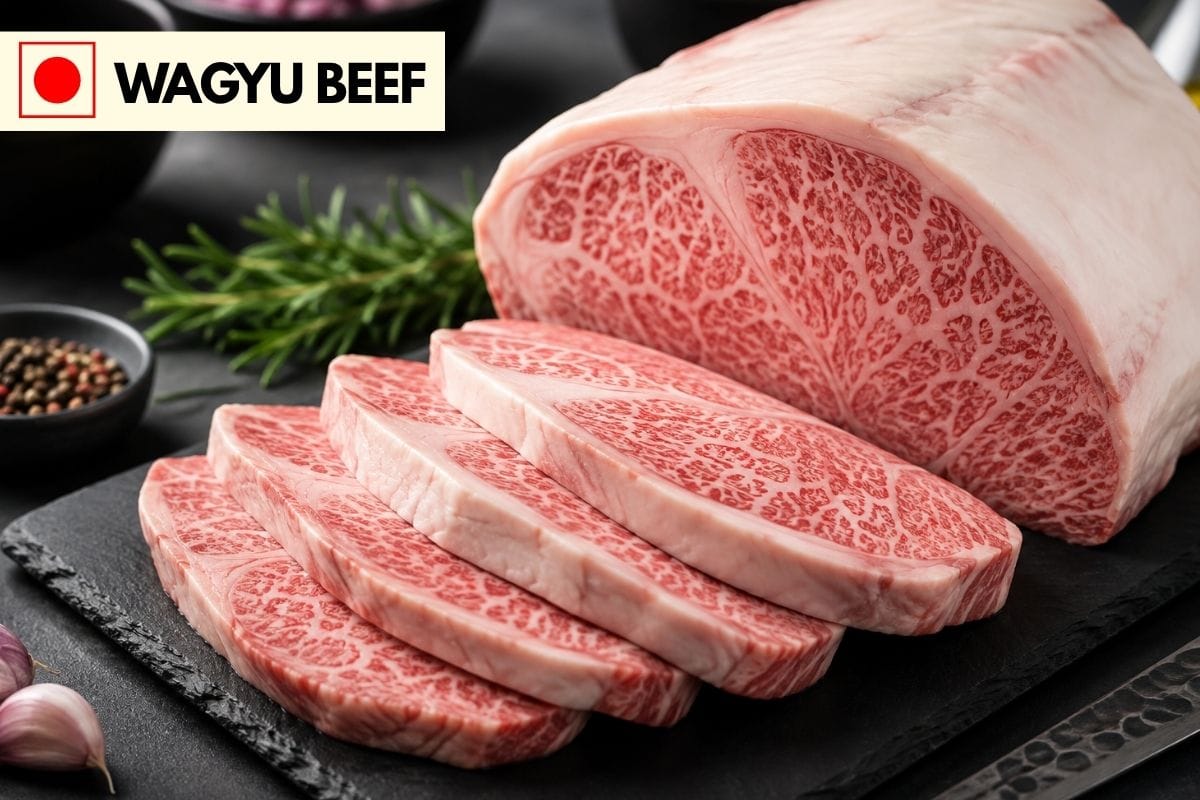
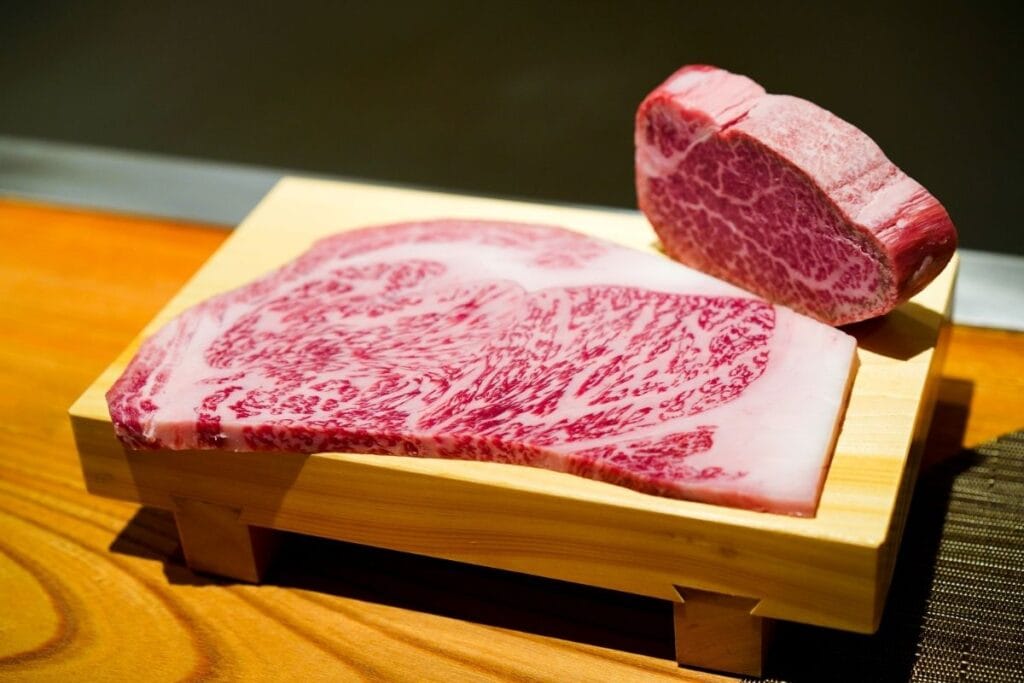
Wagyu, written 和牛, translates as Japanese cow. It refers to beef from four specific Japanese cattle breeds, bred over generations for intramuscular fat that runs through the muscle in fine threads rather than sitting around the edge.
Top-grade Japanese wagyu can be more than half intramuscular fat by composition. The fat melts near body temperature, which is why a small piece dissolves rather than chews.
The Four Breeds
| Breed | Japanese name | Share of production |
| Japanese Black | Kuroge Washu | Over 90% |
| Japanese Brown | Akage or Akaushi | Small |
| Japanese Shorthorn | Nihon Tankaku | Small |
| Japanese Polled | Mukaku | Rarest |
Japanese Black accounts for nearly all the hyper-marbled beef that made wagyu famous. Japanese Brown, sometimes sold as red wagyu, is leaner with a more pronounced beef flavor, and it has a following among people who find A5 too rich. For readers exploring unusual premium cuts, the sweetest meat you need to try can also be an interesting comparison, particularly when looking at how fat, flavor, and preparation change the eating experience.
How Does the Grading Work?
Japanese beef is graded by the Japan Meat Grading Association, a third party independent of the seller. A grade looks like A5, and both characters are commonly misread.
The letter A to C is the yield grade. It measures how much saleable meat the carcass produces. It says nothing about how the beef tastes. An A grade means an efficient carcass, not a superior one.
The number 1 to 5 is the quality grade. It is assessed on four factors at the ribeye cross-section: marbling, meat colour, firmness and texture, and fat colour and quality.
The rule that matters: the quality grade equals the lowest of those four scores. Spectacular marbling paired with poor fat colour produces a lower grade, not an average. Grade 5 requires excellence on every measure.
The BMS Scale, And Why A5 Is Not One Thing
Marbling is scored separately on the Beef Marbling Standard, running from 1 to 12.
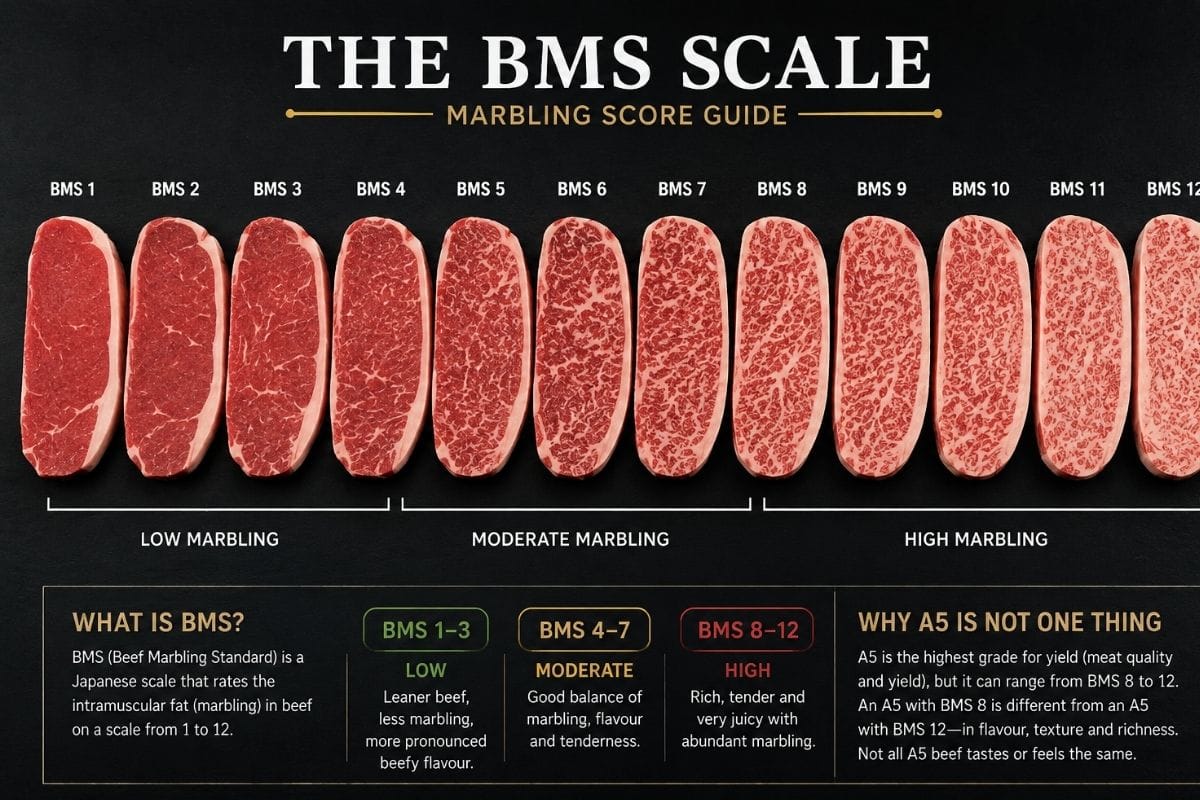
A5 requires a BMS of 8 or above. That means A5 covers BMS 8 through 12, a range wide enough that two pieces of A5 can differ substantially in richness and in price. A restaurant advertising A5 has told you the beef cleared the bar. It has not told you by how much.
The premium regional brands generally sit at BMS 10 to 12.
What Kobe Beef Requires
Kobe is a regional brand, not a grade, and its criteria are among the strictest in the world. To be certified by the Kobe Beef Marketing and Distribution Promotion Association, the beef must:
- Come from the Tajima bloodline of Japanese Black cattle
- Be born, raised and processed in Hyōgo Prefecture, at designated facilities
- Come from a steer or a virgin heifer
- Grade A4 or A5 with a BMS of at least 6
- Carry a 10-digit identification number traceable through Japan’s national database to the individual animal
Every genuine cut has that number. If a seller cannot produce one, the claim is unverified.
Other regional brands apply comparable rigour: Matsusaka, from female cattle raised over three years and prized for sweetness, Ōmi, Yonezawa, and Miyazaki, which has won Japan’s national wagyu competition repeatedly and generally costs less than Kobe for similar quality.
Also Read – Places to eat in Leicester Square
All Kobe is wagyu. Almost no wagyu is Kobe.
American Wagyu is a Different Product
Wagyu genetics left Japan before the country designated the breeds a national living treasure and restricted exports. Those animals founded herds in the United States and Australia.
Most American Wagyu is F1 crossbred, roughly half Japanese Black and half Angus. It is grain-finished for 300 to 500 days and typically lands around BMS 5 to 7. Full-blood American Wagyu exists and makes up a small fraction of US production.
The comparison is not a ranking. Japanese A5 is a rich, delicate product meant for portions of 100 grams or less. American Wagyu is an intensified version of a great American steak, beefier and more assertive, and it works as a full-sized main course in a way A5 does not.
Australia grades on its own marble score of 0 to 9 or above, and Korea uses a 1++ system. None of these are the JMGA scale. Beef graded outside Japan cannot carry a Japanese A5 certificate, whatever a menu implies.
Also Read – What does umami mean?
Two Myths Worth Dropping
Beer and massage. The stories about cattle drinking beer and receiving daily massages circulate endlessly. A handful of small farms have used such practices, and they are marketing rather than method. The marbling comes from genetics, a long finishing period of roughly 28 to 32 months, and low-stress conditions.
Higher is better. A5 BMS 12 is extraordinarily rich. Many people, including chefs, prefer A4 or a lower BMS for anything larger than a few slices, because the fat becomes overwhelming at volume. Ordering down is not a compromise.
Frequently Asked Questions
What does wagyu mean?
It translates as Japanese cow and refers to four Japanese cattle breeds, principally Japanese Black.
What does A5 mean?
The A is the yield grade, measuring saleable meat from the carcass. The 5 is the quality grade, set by the lowest of four factors, including marbling. A5 covers a marbling range of roughly BMS 8 to 12.
Is Kobe beef the same as wagyu?
Kobe is a regional brand of wagyu, from the Tajima bloodline, raised in Hyōgo Prefecture. Roughly 4,000 cattle qualify each year worldwide.
Is American Wagyu real Wagyu?
It carries Japanese Wagyu genetics, usually crossed with Angus, and is a legitimate product. It is not Japanese wagyu and cannot hold a Japanese grade.
Why is wagyu so expensive?
Long finishing periods of 28 to 32 months, small herds, intensive management, strict certification, and, for Japanese wagyu, limited export supply. Much like the question of why truffles are so expensive, the price reflects scarcity, production methods, and the difficulty of producing something consistently exceptional.
How much wagyu should you serve?
For Japanese A5, roughly 100 grams per person or less. The fat content makes larger portions difficult to finish.
The Bottom Line
Wagyu is a Japanese breed, graded by a yield letter that tells you nothing about flavor and a quality number capped by its weakest factor. A5 is a range, not a point. Kobe is a tiny regional brand with a traceable ten-digit number attached to every cut, and any Kobe claim without that number is a claim rather than a fact.
Sources:
Japan Meat Grading Association grading standards; Kobe Beef Marketing and Distribution Promotion Association certification criteria; Japan’s national cattle traceability database; American Wagyu Association; Australian marble score standards.
Note – Retail prices vary by market and are not stated here.