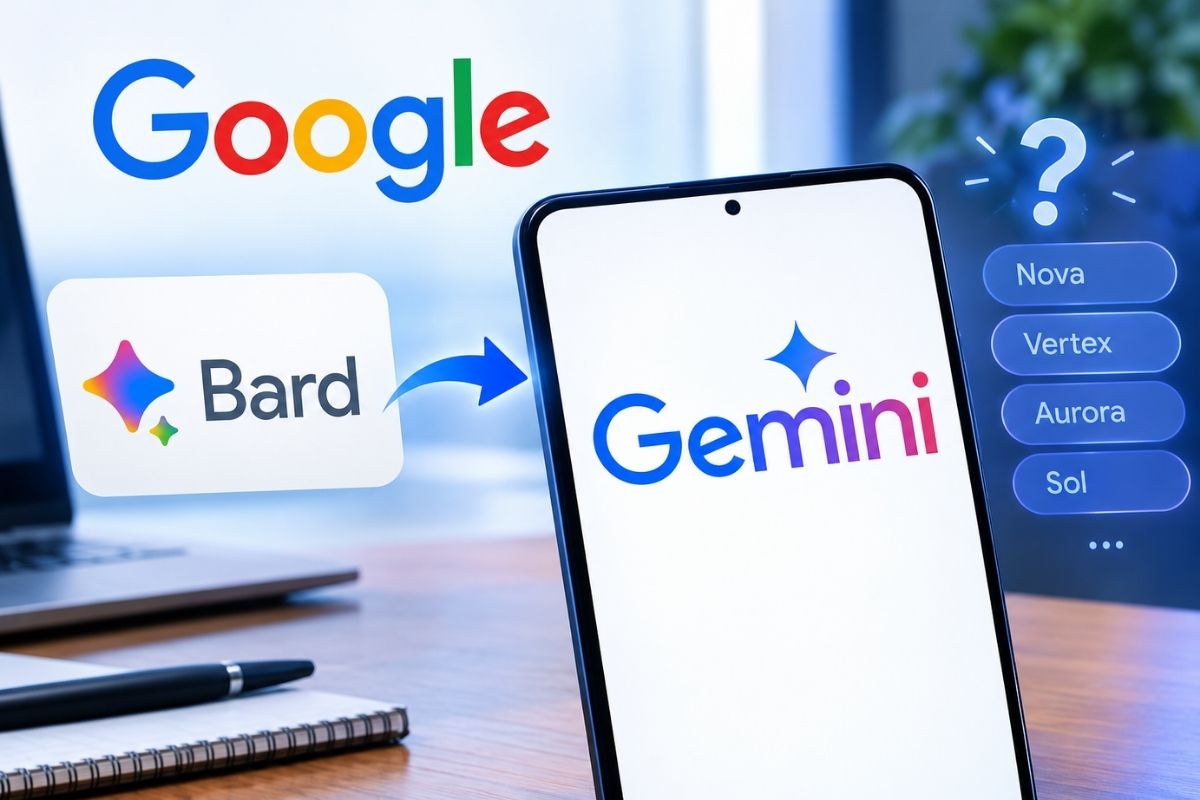
Quick Answer: Google released its AI chatbot as Bard before renaming it Gemini in February 2024. The change put Google’s chatbot and the family of underlying AI models under one brand. Gemini will change its name again, but there’s no official confirmation of this yet. Google’s AI products keep evolving. So, if Google does change the name again, what might the next name be?
Renaming and rebranding its technology products is nothing new for Google, and its artificial intelligence (AI) services are no exception. Bard evolved into Gemini, which now includes a broader ecosystem of AI models and tools.
– Bard came first: Google introduced Bard as an experimental conversational AI service in 2023.
– Gemini replaced Bard: Google officially announced the change on 8 February 2024.
– The name had a wider purpose: Gemini referred to Google’s AI model family as well as its consumer-facing assistant.
– Now what? Any future name is speculation until Google makes a change official.
How Google’s AI Naming Story Started: From Bard to Gemini
1. Bard: Google’s first big chatbot identity
Bard is an experimental conversational AI service from Google that launched in 2023 to help you find information, get ideas, write content, and explore questions naturally.
The launch came as generative AI attracted widespread attention following the success of ChatGPT. Technology companies were competing to develop AI assistants that could answer questions, summarise information and support everyday tasks.
Bard was Google’s answer to that growing demand. However, the name did not remain in place for long.
In December 2023, Google announced that Gemini technology was coming to Bard, initially bringing the Gemini Pro model to the chatbot. The company also announced plans for a more powerful experience powered by Gemini Ultra.
2. Gemini: The rebranding that was a game-changer
On February 8, 2024, Google officially announced that Bard was becoming Gemini. The company explained that Gemini represented its most capable family of AI models and that the new name would reflect the technology powering the experience.
The change was more than a cosmetic update. Google also launched Gemini Advanced and began to roll out a dedicated mobile experience, adding to the ways users could interact with its AI.
The Gemini name connected the chatbot more directly to the models behind it. Rather than presenting Bard as a separate conversational product, Google could build a broader identity around Gemini across its growing AI ecosystem.
That distinction is important today. Gemini is not simply another name for a chatbot; the branding also covers the technology and experiences that support Google’s AI ambitions.
Also Read – How to Use Google Authenticator Transfer to a New Device
3. Why did Google move away from Bard?
Google has not publicly described every factor behind its decision, but its official announcement provides a clear explanation: the Gemini name better reflected the AI models powering the service.
There are several practical reasons why a technology company might choose a unified brand:
In short, the Bard-to-Gemini transition aligned Google’s consumer-facing AI experience with its underlying model family. Whether the move made the product easier to understand for every user is a separate question, but the branding strategy was clear.
What Could Google Rename Gemini To Next?
This is where the story becomes interesting. If Google ever decides to replace the Gemini name, it would need to consider whether a new identity offers a meaningful advantage over its existing brand.
At present, the following ideas are speculative possibilities, not confirmed Google plans.
1. Google AI.
A simple name like Google AI might make the service more recognizable, especially among people who already associate Google with search, Android, and Gmail. But Google AI is also the umbrella term for the company’s artificial intelligence work, so tying it to one product name could make it less clear how individual tools differ.
2. Apollo
Apollo would be an interesting hypothetical successor, following the space-related theme behind Gemini. Google’s own description of the Gemini name even mentions that inspiration came from NASA’s Project Gemini, even talking about Apollo when looking back at naming ideas for the future. Which makes Apollo a fun talking point, but not proof of a planned rebrand.
3. A brand new AI brand
It could theoretically introduce a totally new name if Google’s product strategy changed dramatically. A new identity could differentiate future AI assistants from their chatbot predecessors. However, creating another brand would also require users to learn a new name and understand how it relates to existing Google services.
Of these possibilities, Apollo has a documented connection to the story behind the Gemini name, while Google AI is a straightforward branding concept. Neither should be presented as Google’s confirmed next choice.
Also Read – How Do I Turn Off the Subtitles on Netflix?
Google’s History of Renaming Technology Products
The Bard-to-Gemini transition is part of a broader conversation about how technology companies organise and rename their services.
Google has previously rebranded products as their functions and positions within its ecosystem have evolved. Another example of Google Workspace’s efforts to unify similar experiences under a more consistent branding in the AI space was the shift from Duet AI branding to Gemini branding.
These changes can help companies signal a more cohesive product strategy, but they can also create confusion.
The lack of a known name can lead users to wonder if the product has changed, if what they already know will still work, or if they will have to learn a new interface.
That is why a successful rebrand needs more than a new logo. It needs a clear explanation of what has changed, what remains the same, and why the new identity is useful.
Is Google Actually Renaming Gemini Again in 2026?
There is no official confirmation in any of the sources reviewed that Google is renaming the Gemini product again.
Google’s latest AI announcements are still under the name Gemini. For instance, its official updates in October 2026 talk about Gemini 4 Argon and other updates in the Gemini app: The published release notes speak of new capabilities and integrations, not a new name for the overall product.
Why it matters: Not all AI model updates, new subscription tiers, or feature changes mean the entire product has been renamed.
For example, a company may have a new generation of a model but keep the existing name for its assistant. It could also rebrand some specific tool, but keep the overall AI branding intact.
Any news of a rebranding of Gemini again should be taken with a pinch of salt until Google makes an official announcement.
Also Read – Types of USB Cable
What Would Another Gemini Rebrand Mean for Users?
If Google does rebrand Gemini, how much that matters will depend on how it’s done.
Changing the name might affect how everyday users know the app, get support, and follow product updates. For businesses and developers, that could mean updating documentation, marketing materials, and references to Google’s AI services.
Tech sites and publishers would also have to uncouple the product’s history from the present identity. If you keep referring to Bard as if it’s Google’s current chatbot, you might confuse readers looking for the latest information.
However, a new name would not automatically mean that the underlying AI technology had changed. Product branding and technical development are related, but they are not the same thing.
For that reason, the most useful question is not simply whether Google will choose another name. It is whether a new name would communicate a genuine change in the product or merely create another branding transition.
Conclusion: From Bard to Gemini, What Comes Next?
The switch from Bard to Gemini by Google is a sign of how rapidly the artificial intelligence space is moving. Bard was the launch of Google’s conversational AI identity, and Gemini in February 2024 consolidated the chatbot and its underlying model family under one name.
Could Google someday choose another name? It’s possible, as with any evolving technology product, but there’s no verified official announcement confirming another Gemini rebrand at this time.
For now, Gemini remains the name to know. And if Google ever decides to change it, the announcement will need to explain more than what the product is called — it will need to show users why that change matters.
Also Read – Can You Trust Meta Muse?
Frequently Asked Questions
1. What was Google Gemini called before?
Google’s AI chatbot was known as Bard before it was officially renamed Gemini on 8 February 2024.
2. Why did Google rename Bard to Gemini?
Google said the Gemini name better reflected its family of AI models, which powered the chatbot and its expanding AI experiences.
3. Is Google renaming Gemini again in 2026?
None of the sources reviewed confirm any further renaming officially. Check Google’s official channels if you see stories to the contrary.
4. Could Google rename Gemini to Apollo?
Apollo is an interesting hypothetical possibility, as Google’s explanation of the name Gemini talks about NASA’s space programs. But Google has not confirmed Apollo as a replacement name.
5. Will Gemini stop working if Google changes its name?
A future rebrand would not automatically mean the service would stop working. Google’s actual announcement would include any change in availability, features or access.